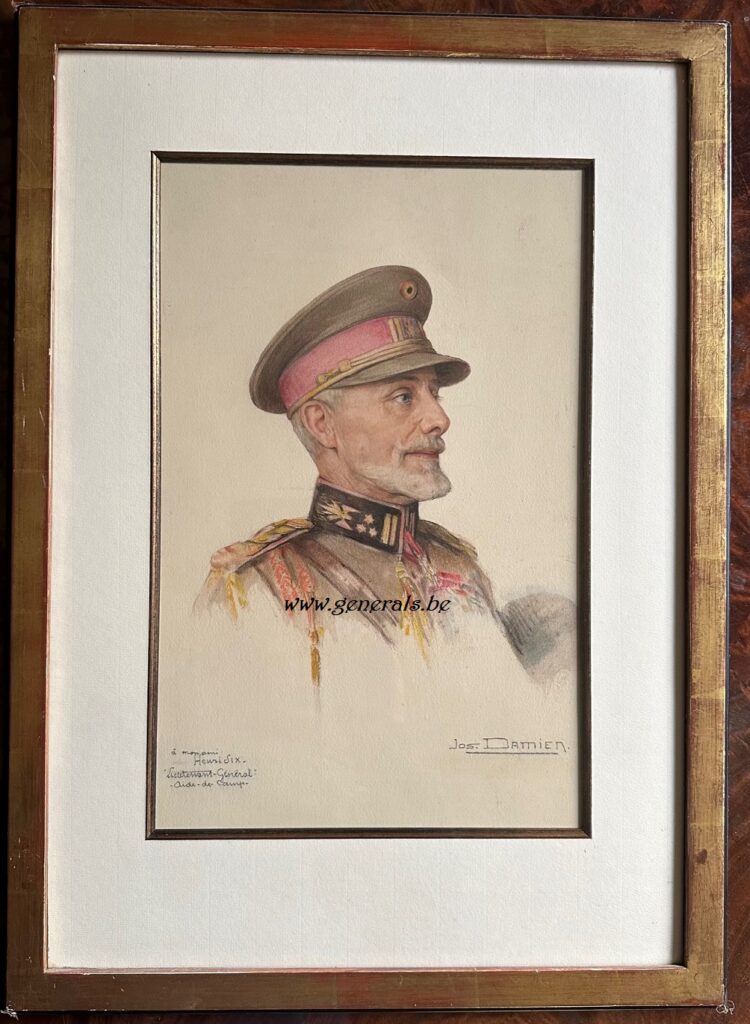
Commander of the 18th Infantry Division, 1939–1940, following his call-up to active service.
The 18th Infantry Division was a unit of the Second Reserve. The division consisted mainly of older reservists (conscripts from 1928–1931) and was less heavily armed than the active divisions in May 1940. The division took part in the fighting at the Dessel-Turnhout Canal (10–13 May), withdrew to Ghent (14–22 May) to take part in the defence of Ghent and eventually surrendered.
Commander of the Province of Brabant, 1935–1937.
Aide-de-camp to the King, 1934–1937.
Commander of the 1st Grenadier Regiment, 1933–1935.
Aide-de-camp to the Duke of Brabant, 1930–1934.

Grand Officer of the Order of Leopold (1940), Order of the Crown (1939) and Order of Leopold II (1946), War Cross 1914–1918 with Palms, War Cross 1940 with Palm, Yser Cross, Fire Cross, Commemorative and Victory Medal 1914–1918, Military Cross 1st Class, Commemorative Medal 1830–1930.
Commander of the Legion of Honour, France (1934), Sword of the Order of Sweden (1934), Al Merito, Chile (1931), Military Cross, UK (1916).
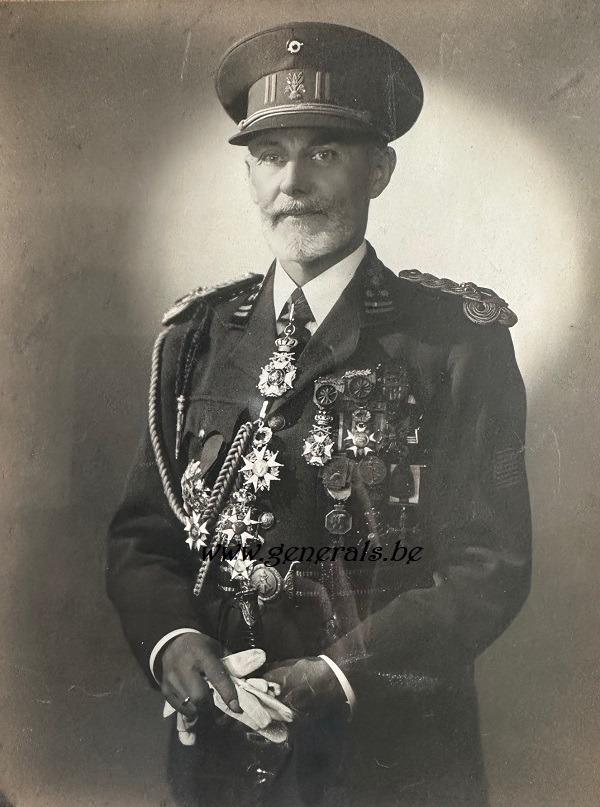
Some of Henri Six’s honourable citations:
Mentioned in the Army Order of the Day on 6 February 1915 for: “A leader of men, full of courage and self-sacrifice, who, despite the intensity of enemy fire, was able to lead and hold his company during the attack on Ramskapelle”. (As a captain in the 6th Ligne Regiment).
Knight of the Order of the Crown, by Royal Decree of 17 October 1915, for: ‘The bravery with which he commanded his company during the campaign, and particularly at the Battle of Putkapelle’.
Knight of the Order of Leopold, by Royal Decree of 1918 for: "A senior officer of exceptional merit, present at the front since the start of the campaign, who has consistently demonstrated the finest military qualities and conducted himself brilliantly during the war of manoeuvre in 1914 and the war of position. Already holder of the Knight’s Cross of the Order of the Crown and the Military Cross. Recipient of a commendation in the Army Order of the Day. Distinguished himself in a most remarkable manner during the Flanders offensive, from 1 to 4 November 1918, commanding the regiment’s vanguard; he took the village of Evergem, heavily defended by enemy machine guns and artillery, through a skilful manoeuvre. He then took possession of the Waalbrug bridge just as the enemy was attempting to blow it up, thus keeping intact an important road leading towards the city of Ghent; capitalising on this success, and despite the exertions of the day, the difficulties of unfamiliar terrain and the darkness of night, he led his battalion to the Lieve, not hesitating to establish a bridgehead at the mouth of the Caale and to push it forward in a spearhead formation; finally, having learnt from refugees that the Germans were preparing to evacuate the village of Wondelgem, he advanced his battalion once more, occupying the village and liberating more than 4,000 of our compatriots who were on the verge of starvation, and pressed on to the outskirts of the city of Ghent and only withdrew on orders. He is adored by his battalion, who asked as a matter of honour not to be relieved and to remain on the front line". As senior captain in the 6th Ligne Regiment.