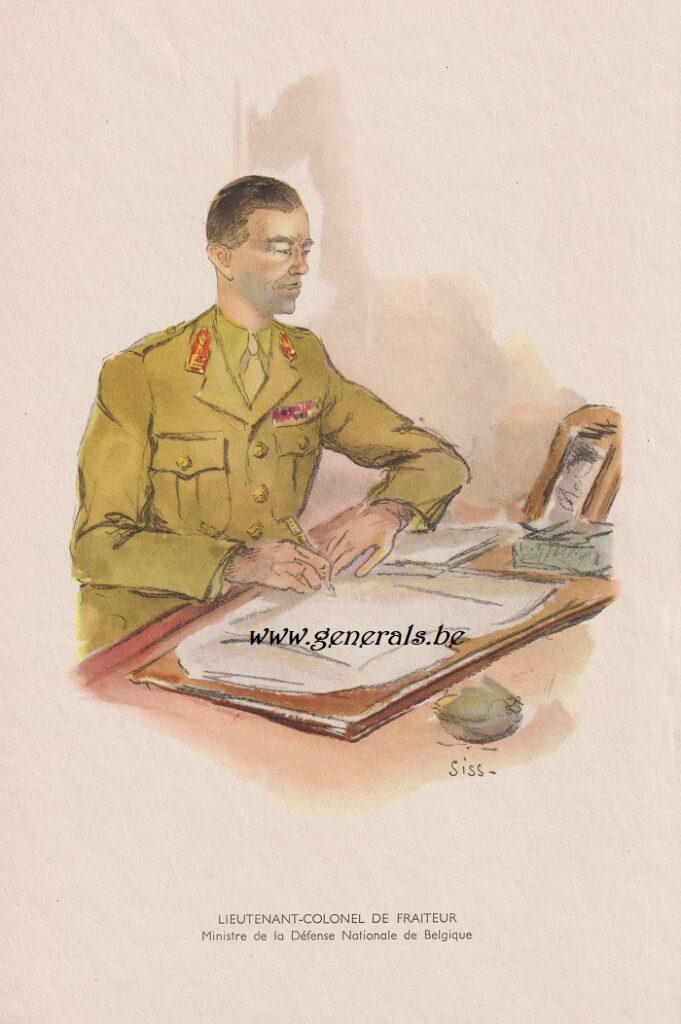
In May 1940, during the German invasion, Raoul de Fraiteur served as a major at the Belgian Army’s General Headquarters. He worked closely with General Raoul Van Overstraeten, King Leopold III’s personal military adviser, due to his technical expertise. This placed him at the heart of military decision-making during the capitulation. Following the Belgian defeat, he, like many other officers, was taken prisoner by the Germans. Just before the surrender, General Van Overstraeten ordered him to bring the regimental standards to safety.
Between December 1940 and the end of January 1941, he was a member of the resistance within the National Royal Movement.
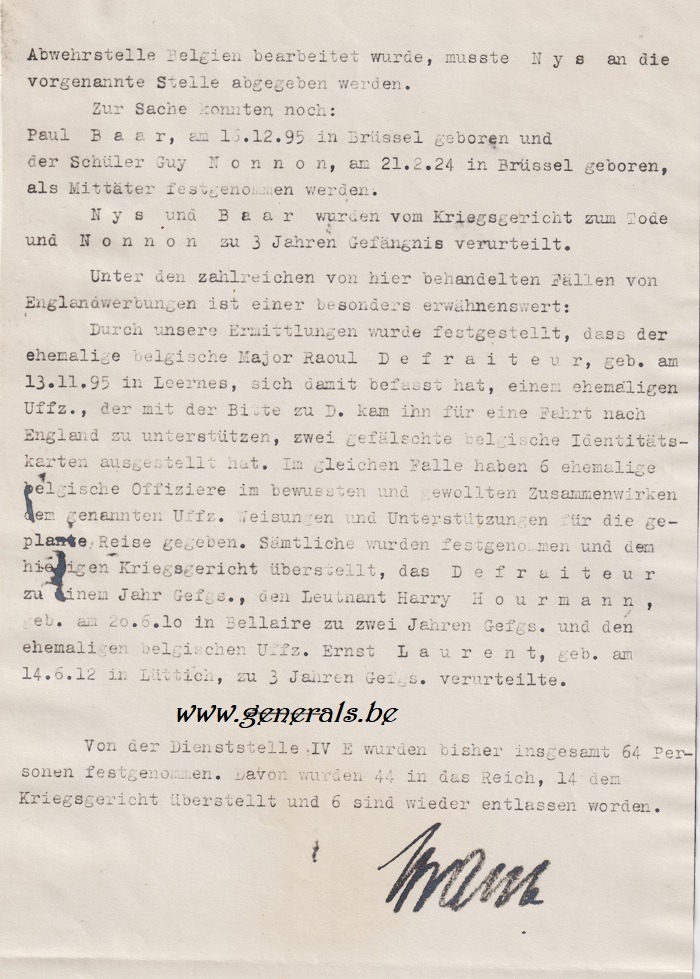
On 28 February 1941, he was arrested by the Sicherheitspolizei on charges of acting in the interests of the UK, recruiting men for the UK army, espionage and sabotage. For this, he was sentenced to one year’s imprisonment. In October 1941, he was released following intervention of King Leopold III.

On 2 May 1942, he fled Belgium and travelled via France and Spain, where he was interned for some time, to England. He arrived in London on 1 December 1942. In London, he was entrusted by Prime Minister and Minister of Defence Hubert Pierlot with an important technical task: preparing the reorganisation of the Belgian units in liberated territory. He worked closely with the Allied High Command to draw up plans for the deployment of Belgian volunteers. This ultimately led to the formation of the fusilier battalions, which were tasked with guarding the Allied lines of communication after the liberation. On 10 September 1944, he returned from London to liberated Belgium. He was immediately appointed to the Defence Minister’s office and to the General Staff to implement the plans he had drawn up in London for the reconstruction of the army.
After the Second World War, Raoul de Fraiteur faced the enormous task of rebuilding the Belgian army from scratch. His policies as minister between 1946 and 1949 were crucial for modern Belgian defence.
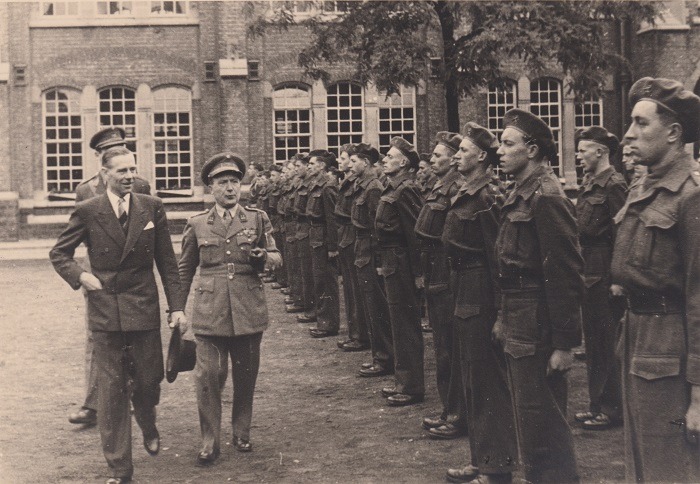
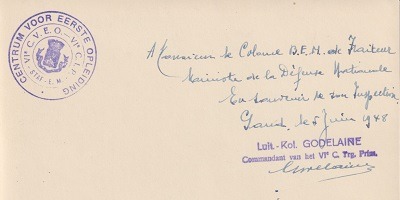
De Fraiteur was not a party politician, but a ‘technocrat’. He was approached in March 1946 to become Minister of Defence because they were looking for a neutral figure who could reorganise the army following the chaos of the war. As minister, he was responsible for transforming the Belgian army from a neutral force into a modern Defence apparatus ready for the Cold War and international cooperation (such as the establishment of NATO).
De Fraiteur recognised that smaller countries such as Belgium and the Netherlands needed to work together to make their voices heard within the new NATO alliance (founded in 1949) and to save costs in rebuilding their armies.
Under Raoul de Fraiteur, the Belgian Navy underwent a complete transformation: from a modest ‘Maritime Corps’ to a fully-fledged, independent force. Since 1996, the Belgian and Dutch fleets have been under a single operational headquarters in Den Helder. The commander is Dutchman and the deputy commander a Belgian. The foundations for joint training were laid under de Fraiteur. Today, Belgian and Dutch sailors attend the same schools, such as the mine countermeasures school in Ostend. To save costs and increase efficiency, both countries purchase ships jointly. A current example is the joint construction of new mine countermeasures vessels and frigates.
The fall of the Spaak government and the return to power of the Christian Democrats on 11 August 1949 marked Raoul de Fraiteur’s departure from the Ministry of Defence.
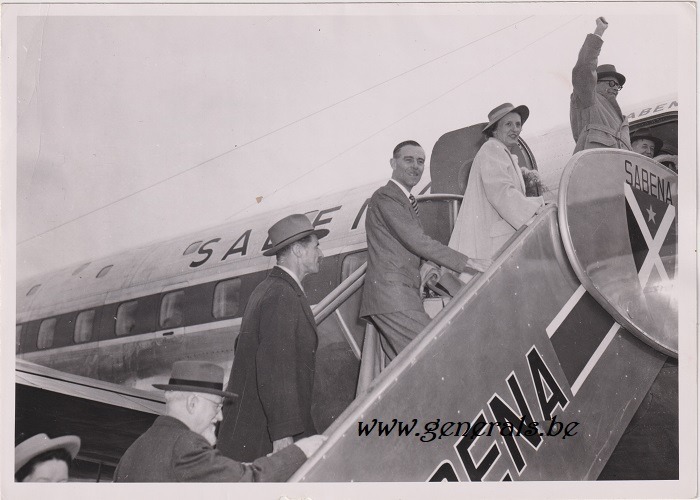
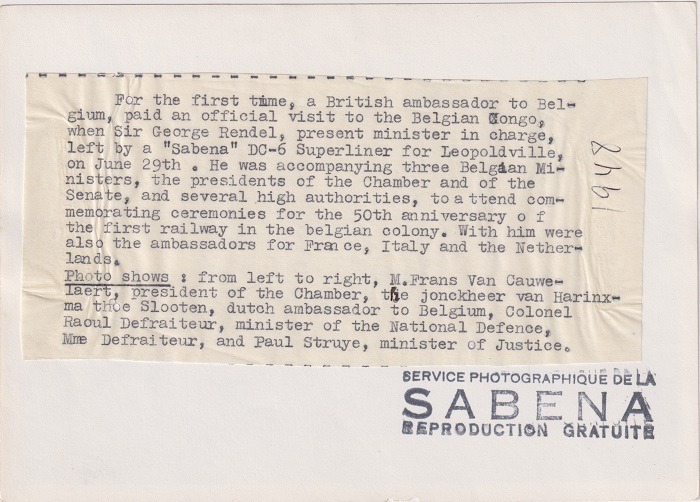
De Fraiteur can certainly be called a brave man, given the commendations and Belgian and foreign decorations for bravery he received during the First World War.

He volunteered for the military service in 1913 with the 9th Ligne Regiment and took part with this regiment in the Battle of Liège, the fighting at Aarschot, the first sortie from Antwerp, Mechelen and Haacht, and the retreat to the Yser following the defence and fall of Fort Waalhem. He was slightly wounded at Lombardzijde.
In February 1915, he became a corporal and was promoted to sergeant on 14 September 1916. In May, he transferred to the 3rd Machine Gun Company, then to the machine gunners of the 4th Chasseurs à Pied.
21 July 1915: transferred to the 8th Line Regiment and mentioned in the regiment’s order of the day on 14 September.
16 July 1916: adjutant to the 9th Ligne Regiment. Transferred to the 18th Ligne Regiment on 1 January 1917.
Appointed auxiliary second lieutenant on 9 March 1917.
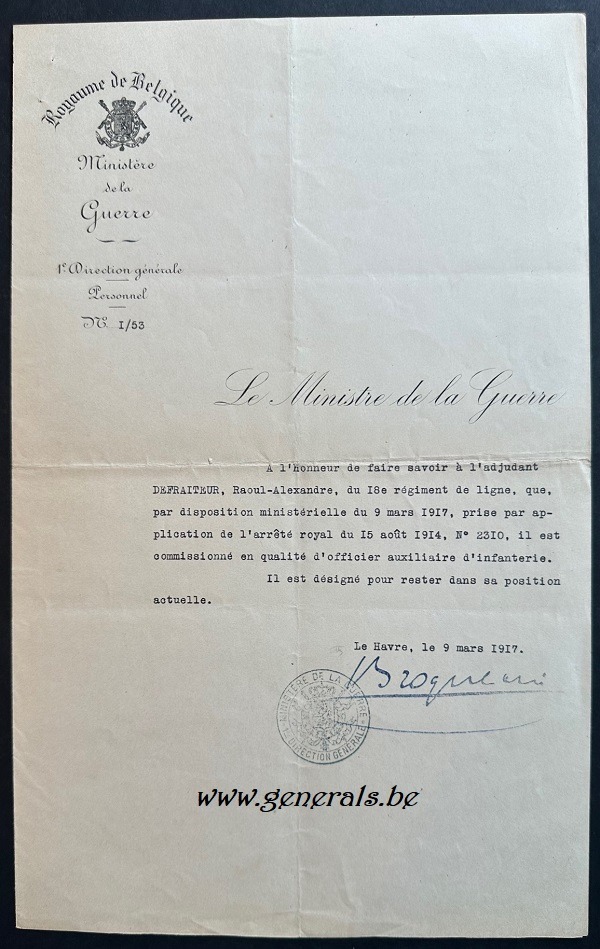
Appointed deputy officer to the battalion commander on 1 August 1917.
3 March 1918, mentioned in the regimental order of the day. Seriously wounded on 5 May 1918, right lung perforated by a rifle bullet whilst on reconnaissance in the Ypres sector, St Julien. Evacuated to the military hospital at Beveren.
Rejoined his regiment as assistant to the major on 31 July 1918.
Struck down by Spanish flu on 10 August 1918. Hospitalised at the military hospital in Cabour.
Rejoined the 18th Ligne Regiment on 3 September 1918 and took part in the entire Flanders offensive.
Mentioned in the regiment’s order of the day on 20 September 1918.
After the war, he attended royal military academy as part of the 64th Infantry-Cavalry promotion, graduating at the top of his class.
Certified for staff duty, 12 August 1928.
Promoted to Captain on 26 March 1929.
Senior Captain, 27 November 1933.
Major, 26 December 1939.
Taken prisoner by the Germans, 29 May 1940.
Released, 16 June 1940.
In service with the regional office for assistance to the families of Belgian military personnel from 1 October 1940 to 27 February 1941.
In service at the Ministry of the Interior, identifying war victims from 1 November 1941 to 1 May 1942.
Lieutenant Colonel, 26 June 1944.
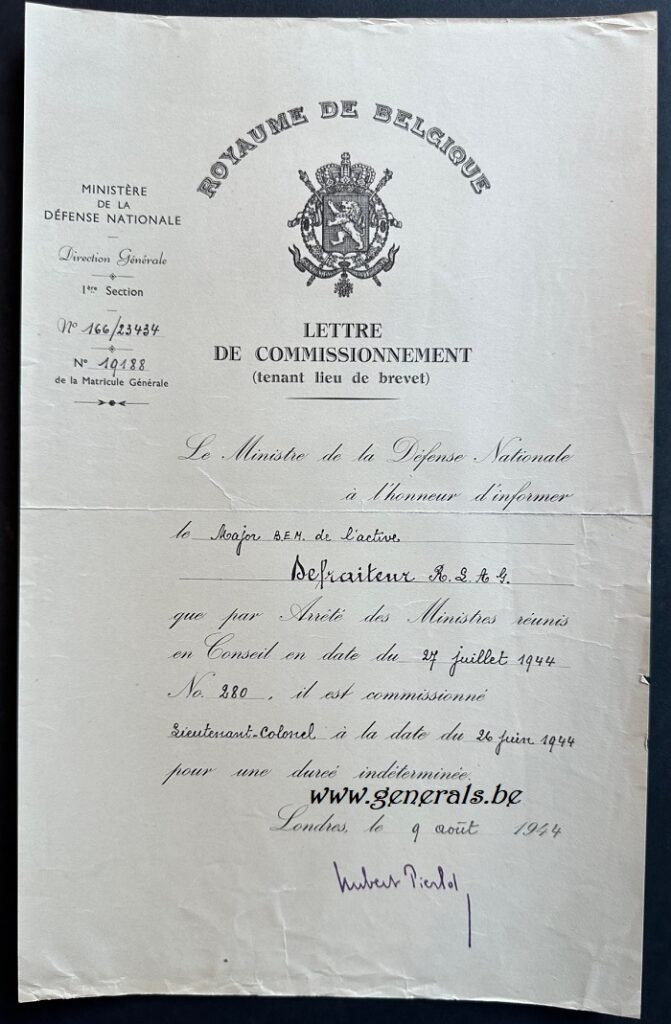
Colonel, 26 March 1948.
Retired, 1 January 1950.
Transferred with his rank and seniority to the reserve, 1 January 1950.
Major General (Reserve), 26 June 1952.

Retired from the reserve cadre due to reaching the age, 16 December 1954.
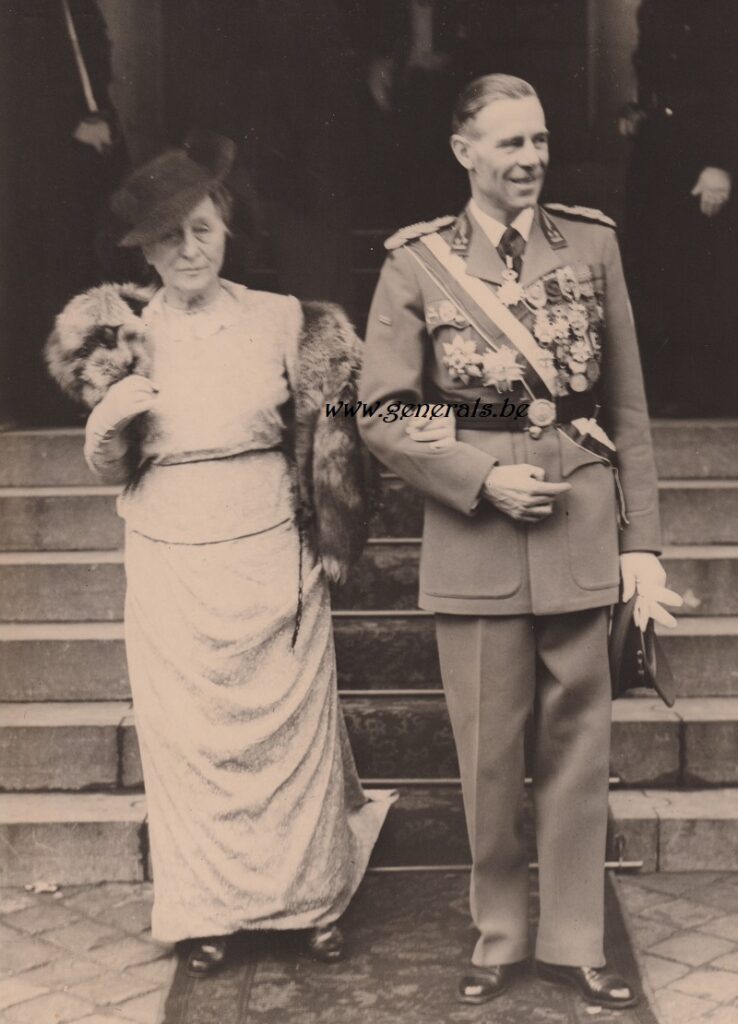
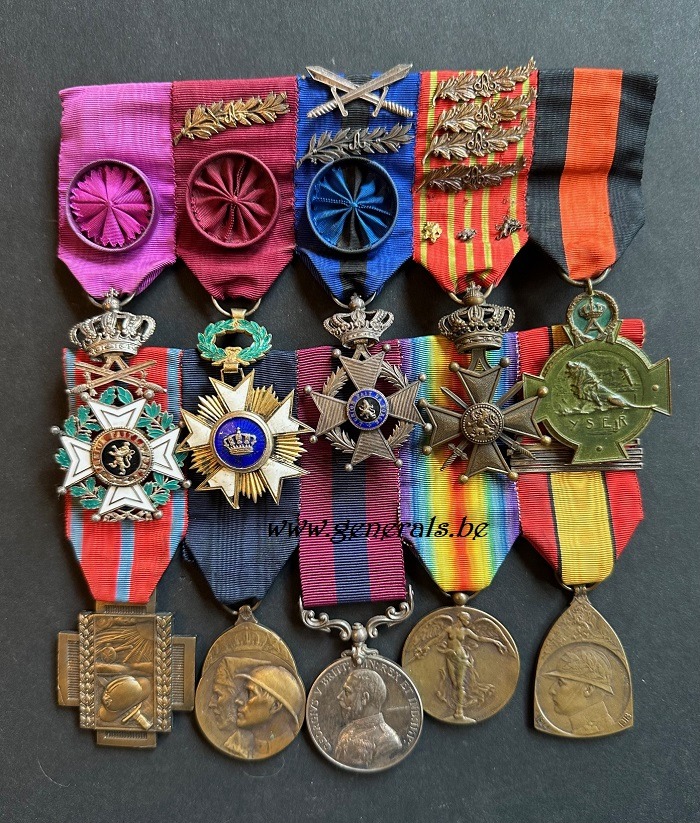
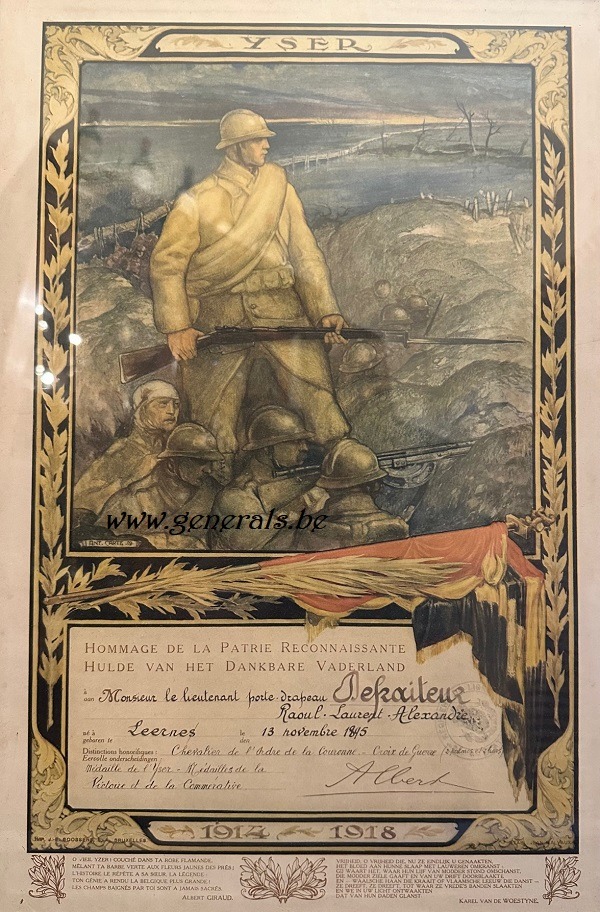
Officer of the Order of Leopold, Order of the Crown and Order of Leopold II, War Cross 1914–1918 with Palms and Lions, IJzer Cross.
Bottom row:
Fire Cross, Volunteer Medal 1914–1918, Distinguished Conduct Medal (UK), Victory Medal, Commemorative Medal of the Campaign 1914–1918.
War Cross, 9 March 1918.

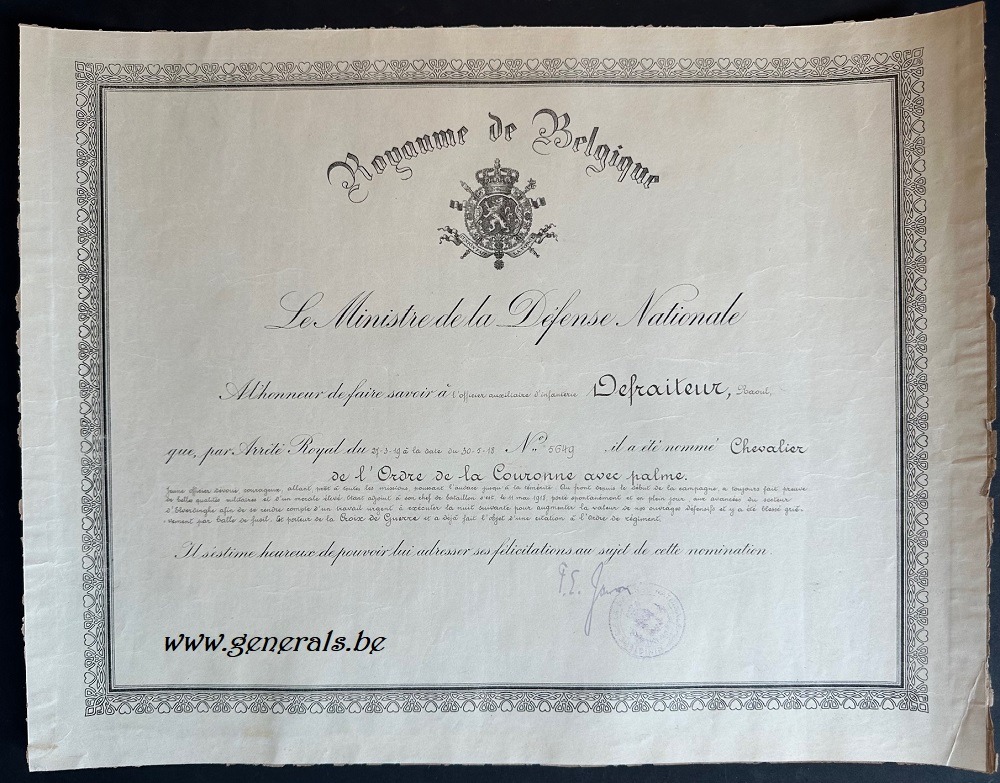
Knight of the Order of the Crown, with palm, dated 30 May 1918, by Royal Decree of 27 March 1919.

Distinguished Conduct Medal (United Kingdom).
Yser Medal, 1 October 1920.
Victory Medal and Commemorative Medal of the 1914–1918 Campaign.
Silver Medal for Military Valour, Italy, 27 April 1922.

Knight of the Order of Leopold, 27 November 1929.
Centenary Commemorative Medal, 27 November 1930.
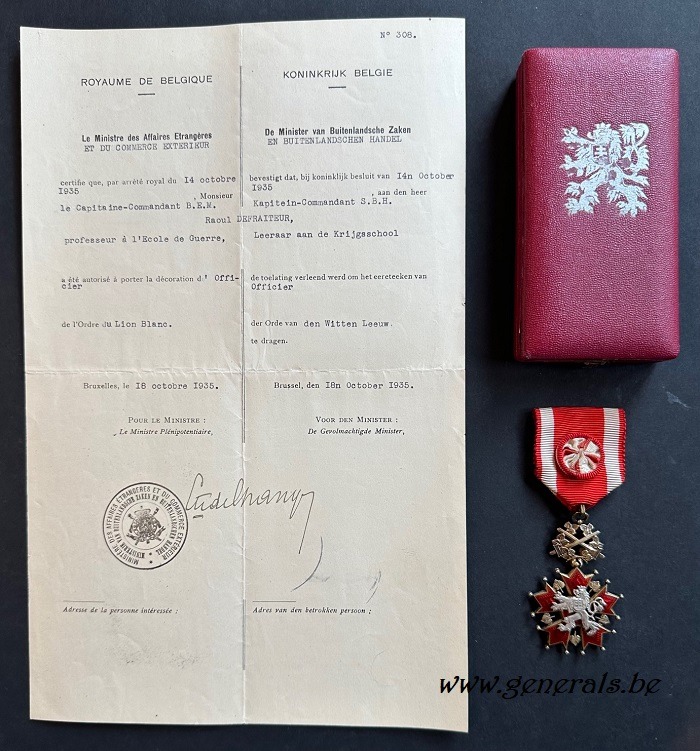
Officer of the Order of the Crown, 8 April 1935.
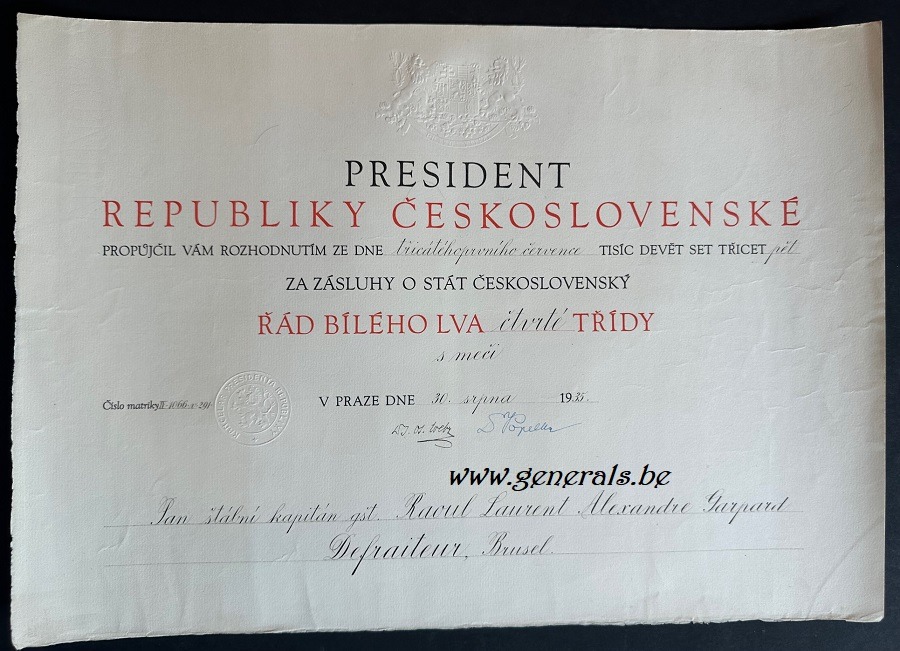
Officer of the Order of the White Lion, Czechoslovakia, 30 September 1935.
Cross of Fire, 15 November 1935.
Authorised to affix an additional palm to the ribbon of the War Cross, 15 November 1936.
Military Cross, 2nd Class, 15 November 1938.
Officer of the Order of Leopold II with swords, 21 July 1939.
Officer of the Order of Leopold, 15 November 1939.
Commander of the Order of the Crown, 8 April 1940.
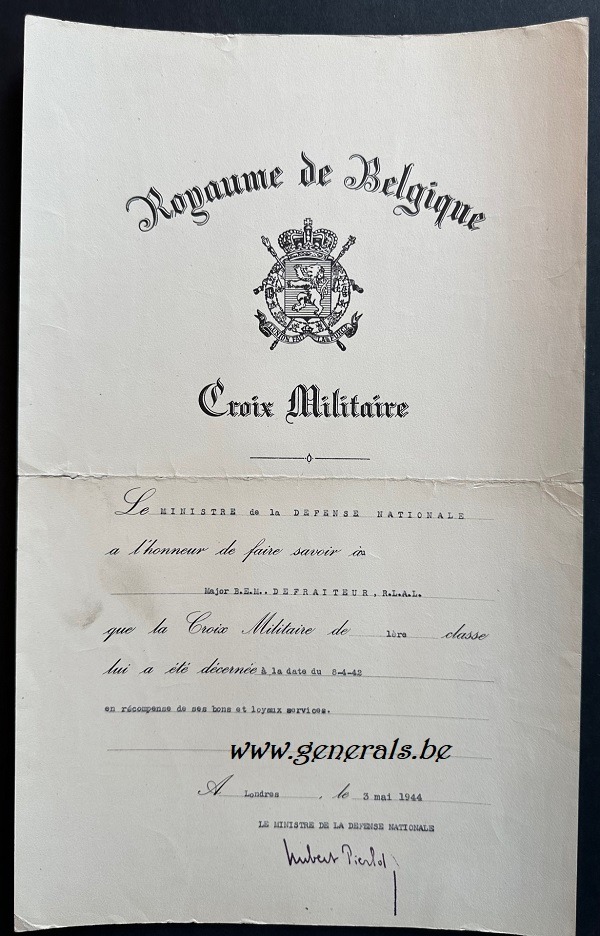
Military Cross, 1st Class, 8 April 1944.
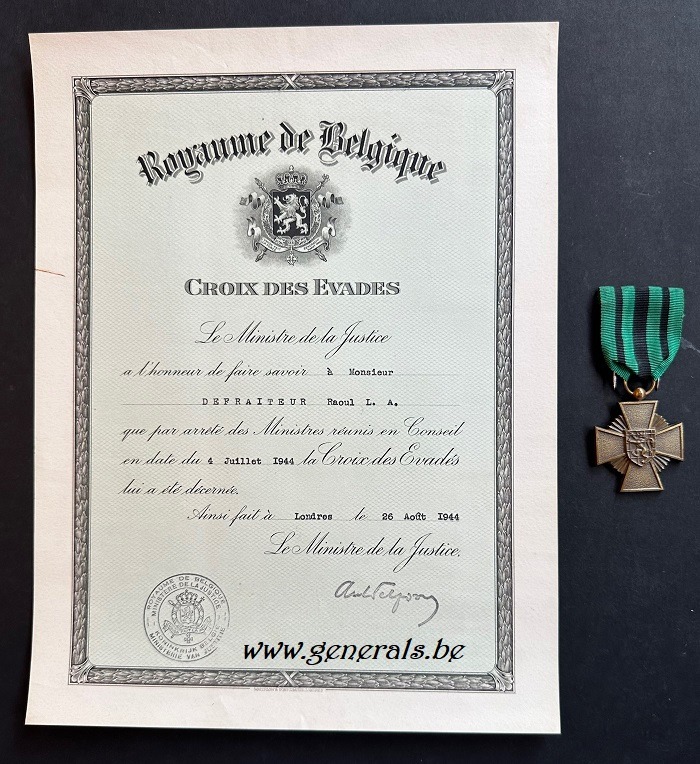
Cross of the Escaped Prisoners, 26 August 1944.
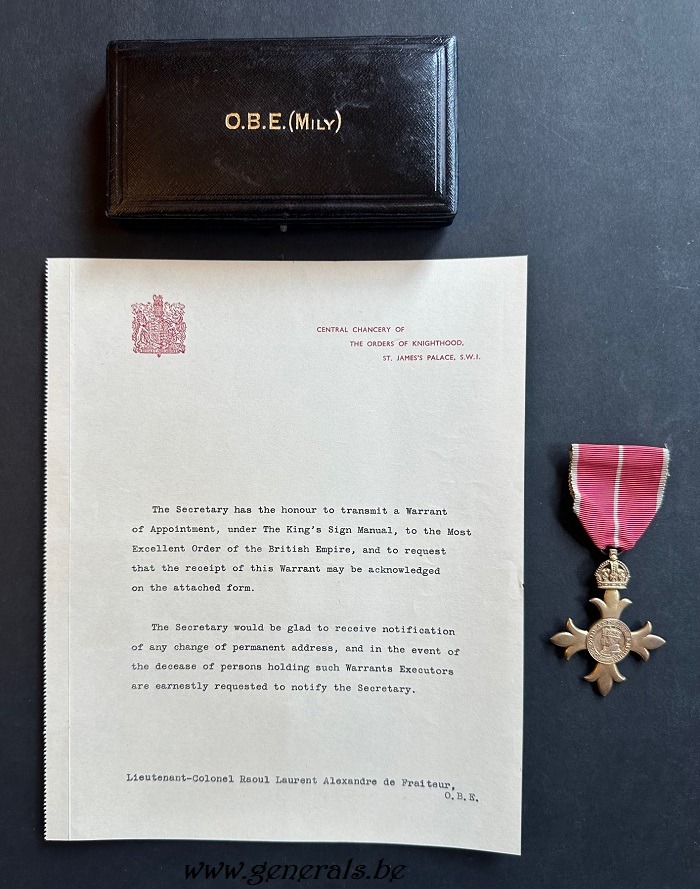
Honorary Officer of the Order of the British Empire, 31 August 1945.

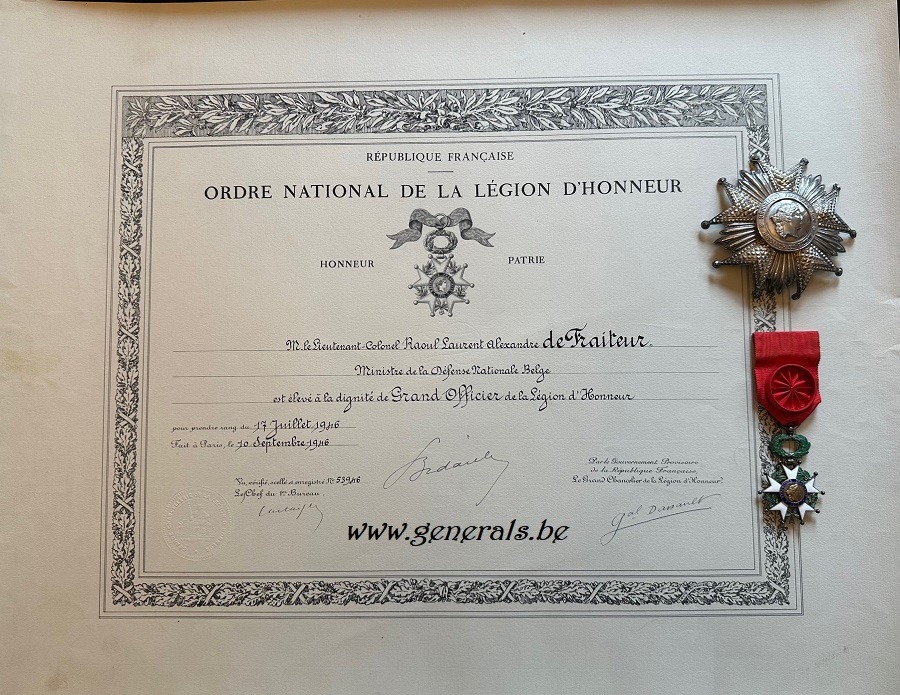
Grand Officer of the Legion of Honour, France, 17 July 1946.
French War Cross 1939–1945, 6 August 1946.

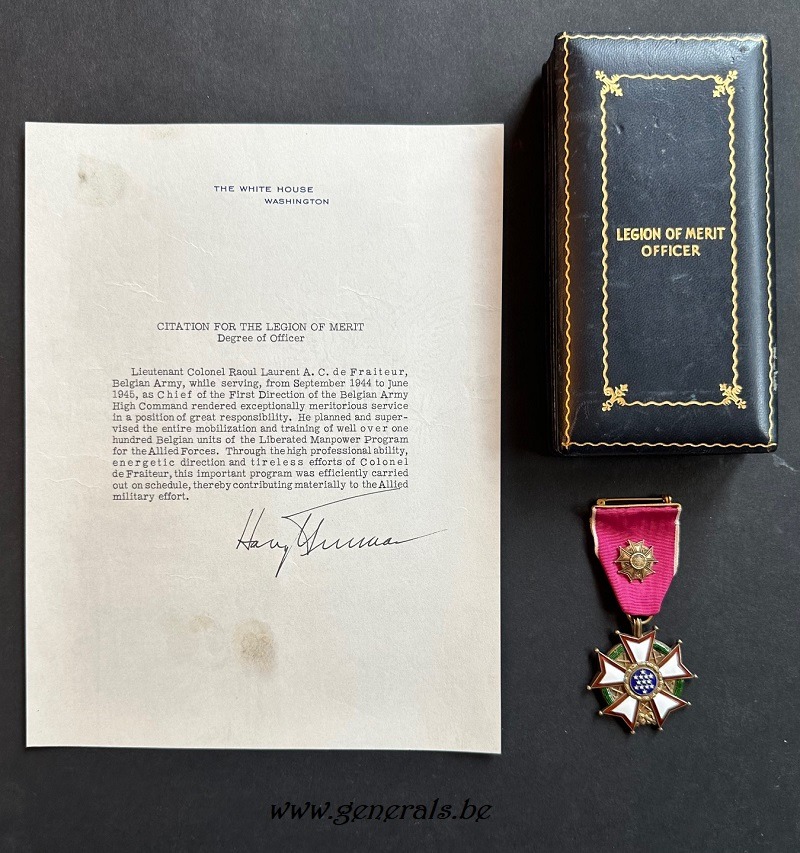
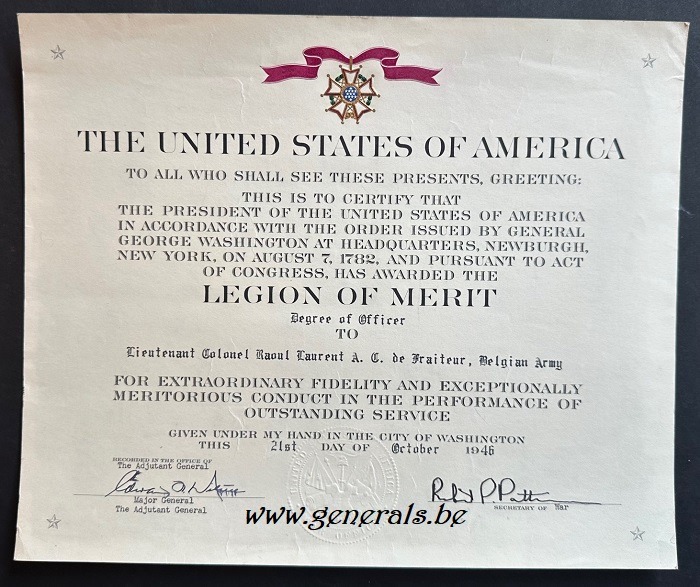
Officer of the Legion of Merit, United States, 21 October 1946.
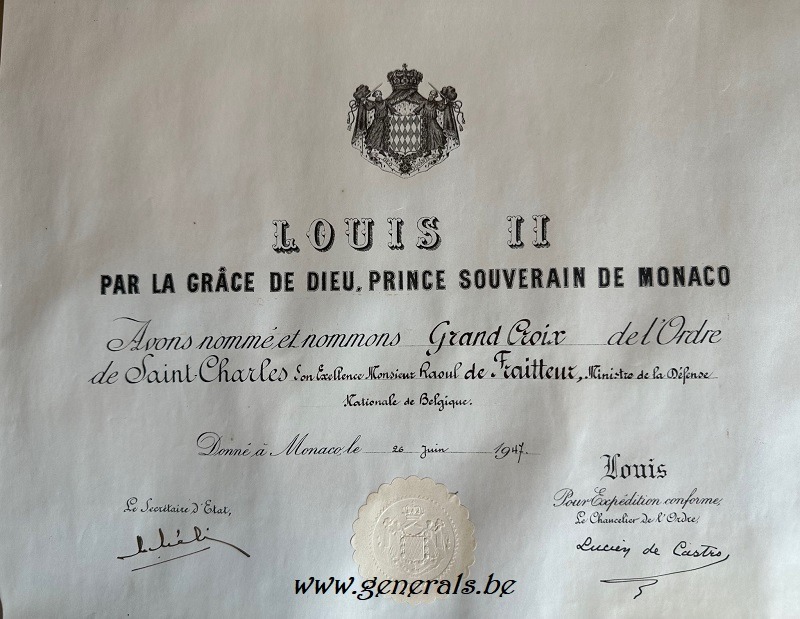
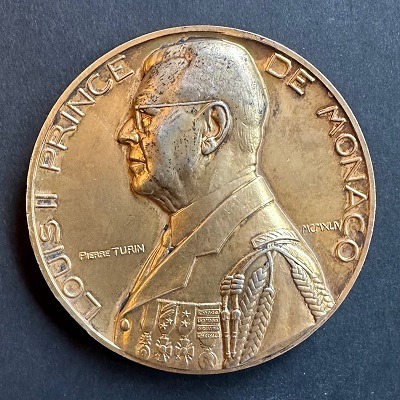
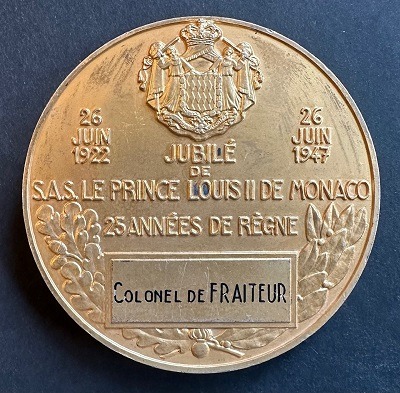
Grand Cross of the Order of Saint Charles of Monaco, 26 June 1947.
Commander of the Order of Leopold, dated 8 April 1948, by Royal Decree of the Regent of 19 September 1949.
Grand Cross of the Order of Orange-Nassau with Swords, Netherlands, 10 May 1948.
Grand Cross of the Order of the Oak Crown of Luxembourg, 26 June 1948.

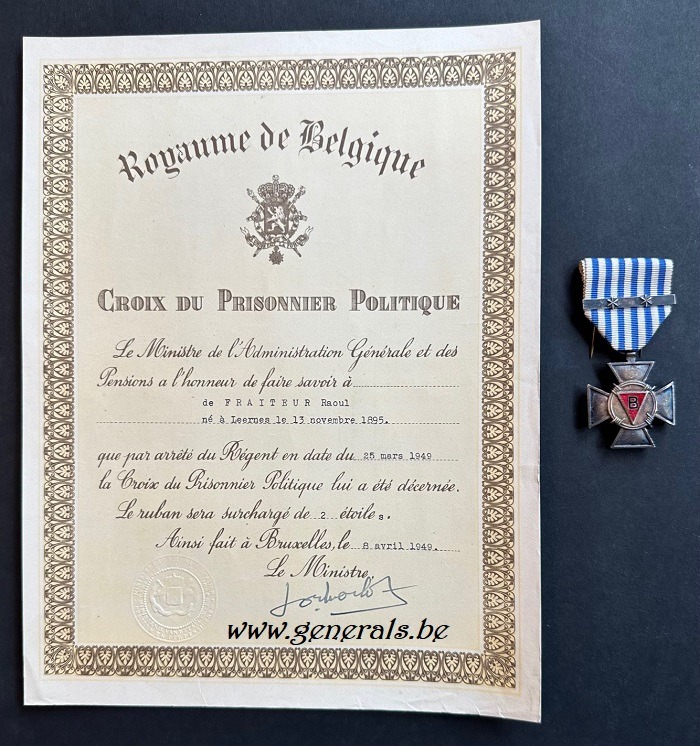
Political Prisoner’s Cross with two stars, 8 April 1949.
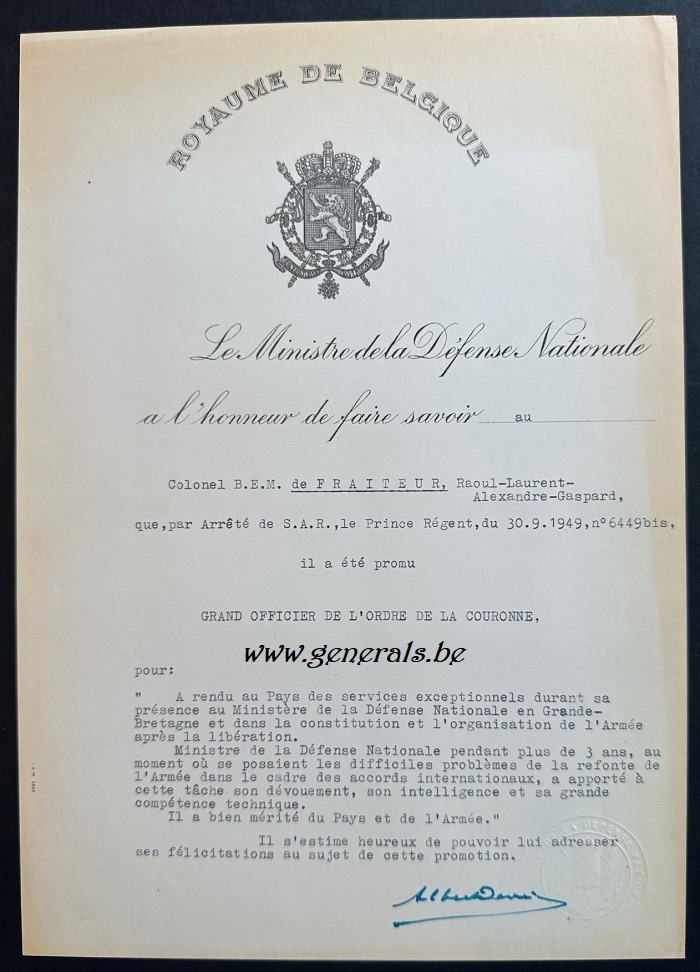
Grand Officer of the Order of the Crown, 30 September 1949.
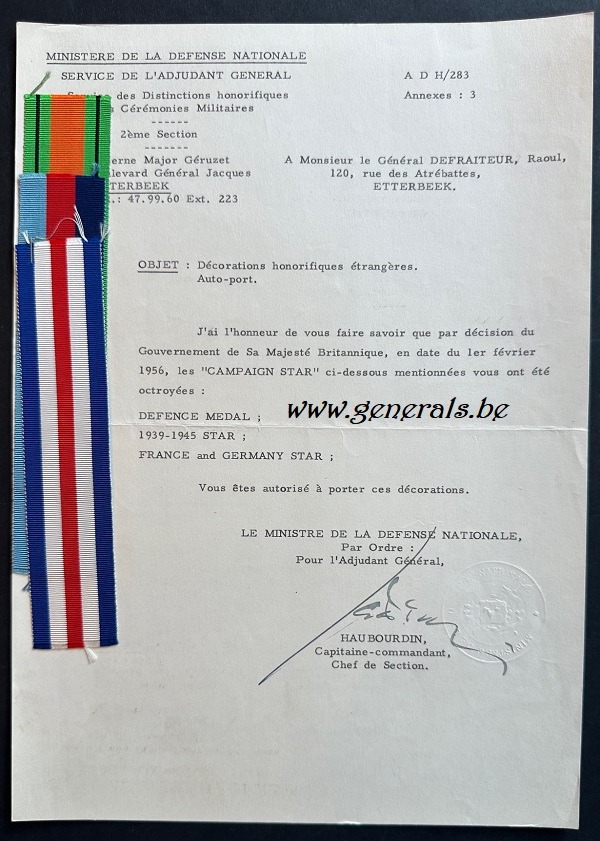
Defence Medal, 1939-1945 Star, France and Germany Star United Kingdom, 28 February 1956.
Medal of Liberated France, 28 December 1960.