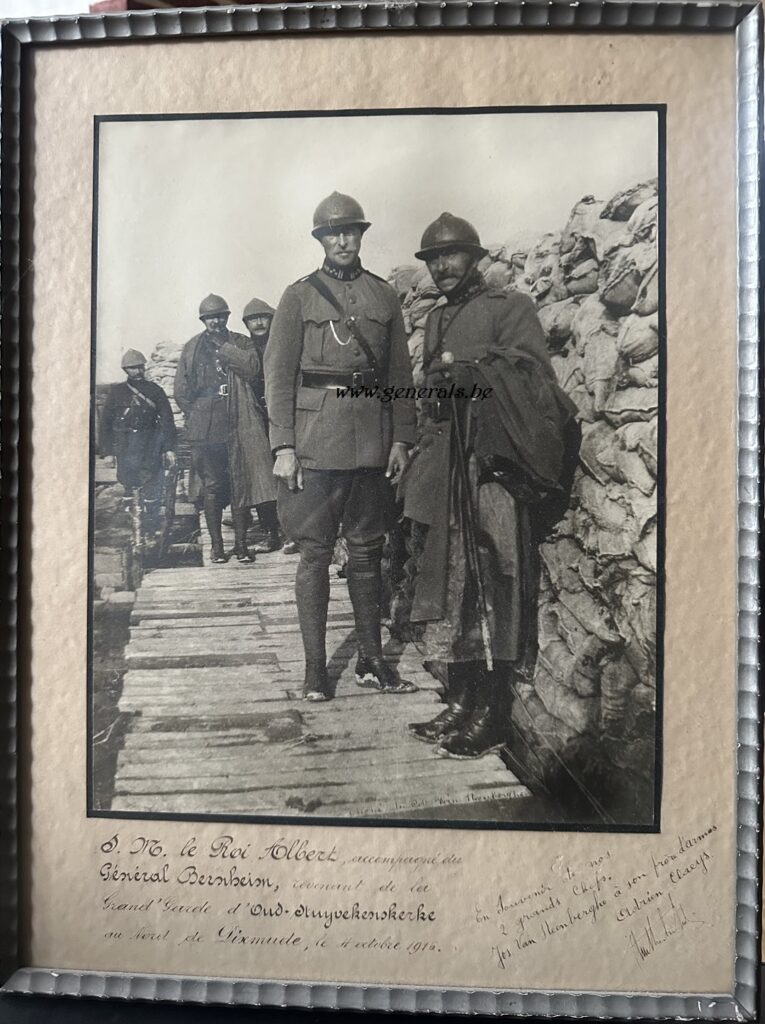
When war broke out in August 1914, he was a colonel commanding the 7th Line Regiment. During that year, he distinguished himself during the first sortie at Haecht during the siege of Antwerp. On 7 September 1914, he was promoted to commander of the 3rd Mixed Brigade and took part in the second sortie from Antwerp. On the Yser front, his brigade defended the Ramskapelle and Pervyse sector. On 21 November 1914, he was appointed Major General.
On 5 January 1915, he was appointed head of the 1st Army Division, a command he held throughout the First World War. His division took part in the bloody battles of Steenstrate in April and May 1915 and, during the first German gas attack, took over from the 6th Army Division at the end of June.
Demonstrating rare courage on the front line, he was seriously wounded in the back by shrapnel on 7 September 1915 while inspecting the trenches. After only two months of convalescence, he returned to the front. On 20 March 1916, he was promoted to lieutenant general. In 1917, he attempted to take action against the emergence of the Frontbeweging, a Flemish movement protesting against what they perceived as anti-Flemish discrimination in the Belgian army. On this occasion, Bernheim was personally criticised by Flemish intellectuals for his strict application of the regulations.
During the liberation offensive in the autumn of 1918, it was his troops who captured the Klerken ridge and the Houthulst forest. In the second phase of the offensive, his group captured Maldegem after a lightning advance and was preparing to cross the Scheldt on the date of the Armistice.
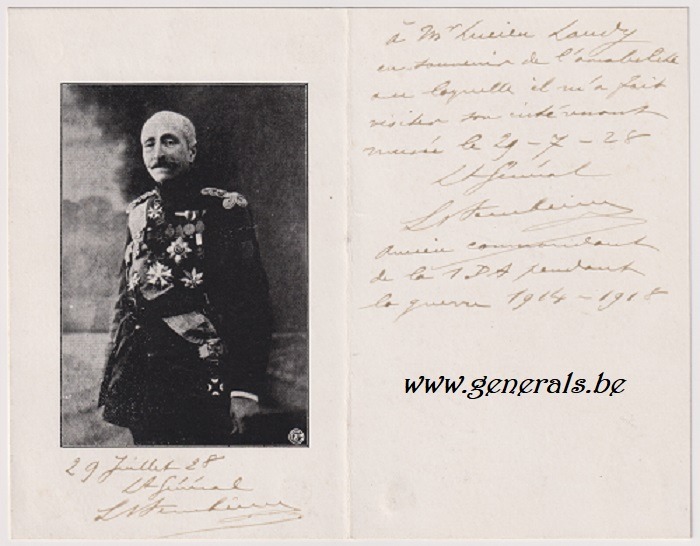
At the end of the war, he was appointed Inspector General of the Infantry. In 1923, he was placed at the disposal of the Ministry of National Defence and retired in 1926.