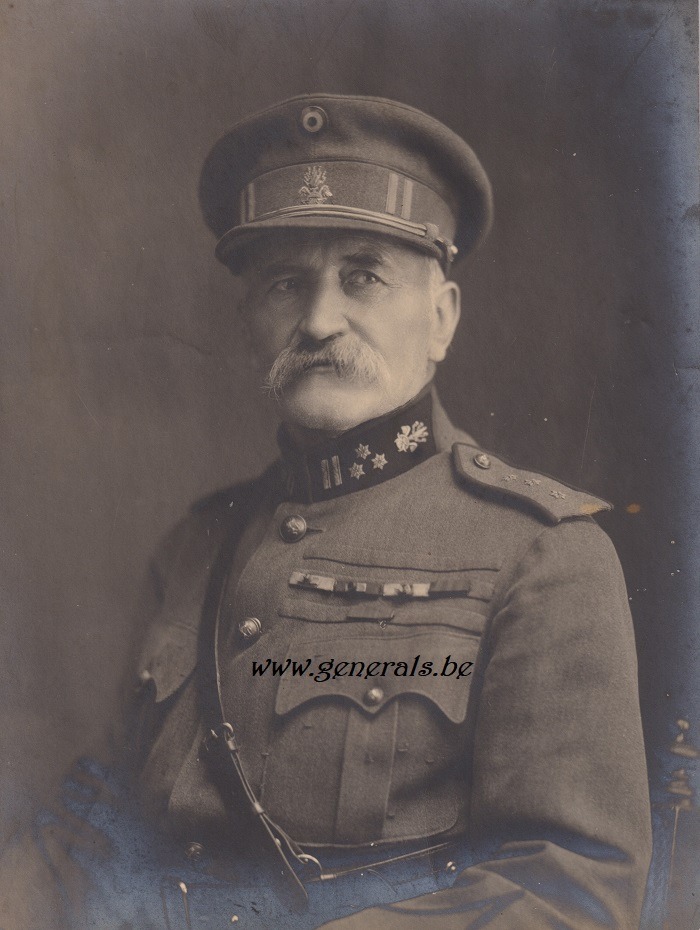
Lieutenant-General Leman had an impressive academic and military career, during which he was renowned as a brilliant mathematician.
He entered the Military Academy as a cadet in 1867 and graduated at the top of his class in 1872 with the rank of lieutenant in the Engineers.
During the Franco-Prussian War of 1870, he served in a Belgian observation corps.
In his role as Director of Studies (from 1894) and later as Commandant (1905–1914) of the Military Academy, he had a profound influence on the academic standards of the school: Stricter admission requirements, he added physics and chemistry to the entrance examination and significantly raised the mathematical standards. Educational philosophy: He believed that an officer should not only be a warrior, but also an intellectual with a solid technical foundation. He demanded strict discipline from both students and professors. His academic rigour earned him the nickname ‘The Sphinx’, due to his unflappable and demanding attitude towards his students, including the future King Albert I.
The Battle of Liège (5–16 August 1914) was the first major engagement of the First World War. Under the command of General Leman, Belgian troops held back the German advance for ten days, which caused a crucial delay to the German Schlieffen Plan.
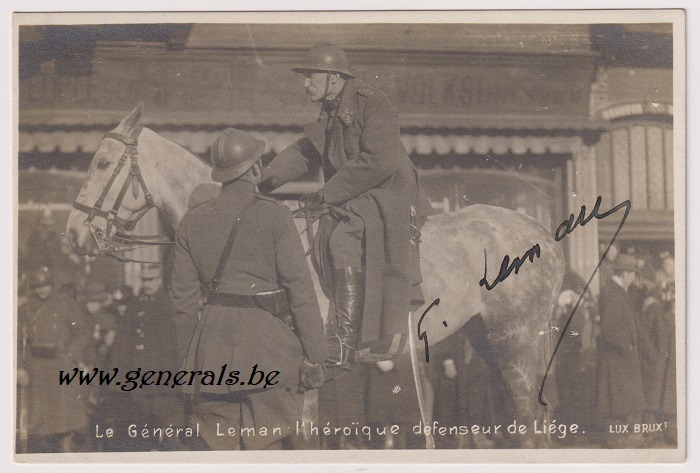
Liège was protected by twelve modern forts. The first German assaults between 5 and 6 August suffered heavy losses from Belgian fire. Despite the resistance of the forts, on 7 August the Germans managed to occupy the city itself by advancing between the forts. To neutralise the remaining forts, the Germans deployed their heaviest artillery for the first time, including the 42-cm ‘Big Bertha’ mortar.
On 15 August 1914, the siege came to a dramatic end for General Leman at Fort Loncin: a German direct hit struck the ammunition chamber, causing the fort to explode. This claimed the lives of 350 of the 550 defenders.
Leman was pulled from the rubble by German soldiers, unconscious and suffocating from gas.
After his capture, he wrote a famous letter to King Albert I, in which he stated: ‘I have surrendered neither the fortress nor the forts’.
Although the forts eventually fell, the four to five days’ extra time that Leman bought gave the French and British armies the chance to mobilise their troops for the crucial Battle of the Marne.
When Leman regained consciousness, he refused to hand over his sabre to the German General Von Emmich. He declared that he had not surrendered, but had simply been overwhelmed by the explosion. Out of respect, Von Emmich allowed him to keep his sabre.
He was imprisoned in the citadel of Magdeburg; on 7 April 1915, he was transferred to the camp at Blankenburg im Mark.
Due to his poor health (he suffered from diabetes and heart problems), he was released by the Germans in December 1917.
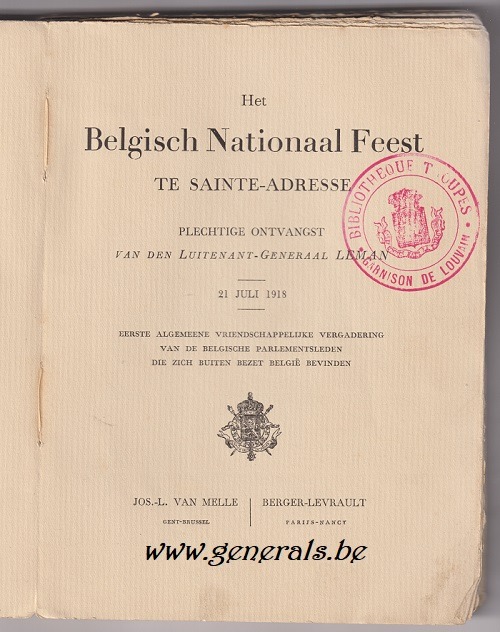
He travelled to Paris and then to the Belgian government centre in Le Havre (Sainte-Adresse), where he was welcomed by the king and the people as a living legend.
After the armistice in 1918, he returned permanently to Liège, where he died of pneumonia in 1920.
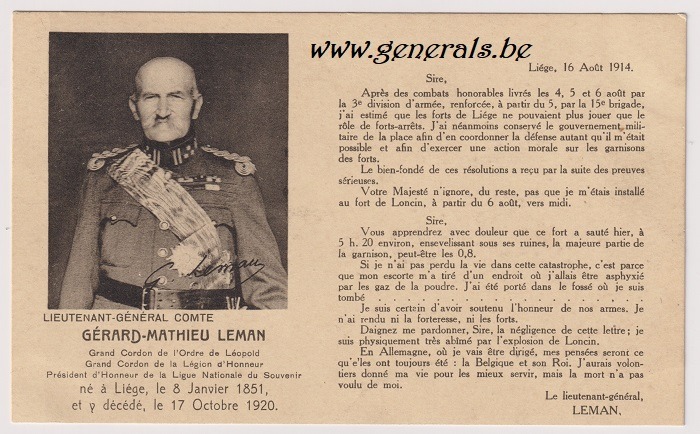
Grand Cordon Order of Leopold with Palm and the 1914–1918 War Cross, awarded by Royal Decree of 6 February 1918. Victory and Commemorative Medal 1914–1918, Commemorative Medal 1870–1871, Military Cross 1st Class, Commemorative Medal of King Leopold II.
Grand Cross of the Legion of Honour, France (1918), Order of St Michael and St George, UK (1918).