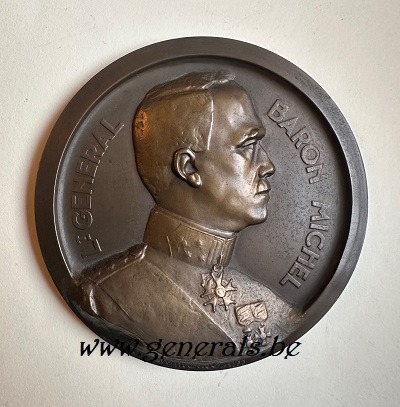
In August 1914, he commanded the 4th Army Division and was governor of the Fortified Position of Namur. Despite the superior strength of the German army, he managed to withdraw a large part of his troops to Antwerp. After the disciplined retreat from Namur and Antwerp, his division took up position at the crucial Battle of the Yser in October 1914.
His division was responsible for defending the sector around Wulpen, a strategic point near Nieuwpoort where the German advance was halted and the breakthrough to the French canal ports.
After the stabilisation of the front, the 4th Division remained stationed in Wulpen from December 1914 until early 1917. For his steadfastness and for saving his division from encirclement (both in Namur and on the Yser), he was elevated to the rank of baron after the war.
After years of being stuck in the mud of the Yser, the troops of the 4th Division advanced rapidly. The division was deployed in the central sector of the Liberation Offensive. On 28 September 1918, they broke through the German lines near Handzame and Kortemark. They played an important role in the liberation of Torhout in mid-October 1918. The offensive drove the Germans back towards the Leie and the Ghent-Terneuzen canal, where the division was stationed at the time of the Armistice on 11 November.
After the armistice, he commanded the Belgian occupation forces in the Rhineland (Aachen and Mönchengladbach) until his retirement in 1920.
In 1923, he was the founding president of the ‘La Fourragère’ circle, which brought together all friends interested in promoting the valuable collections of the Royal Army Museum.
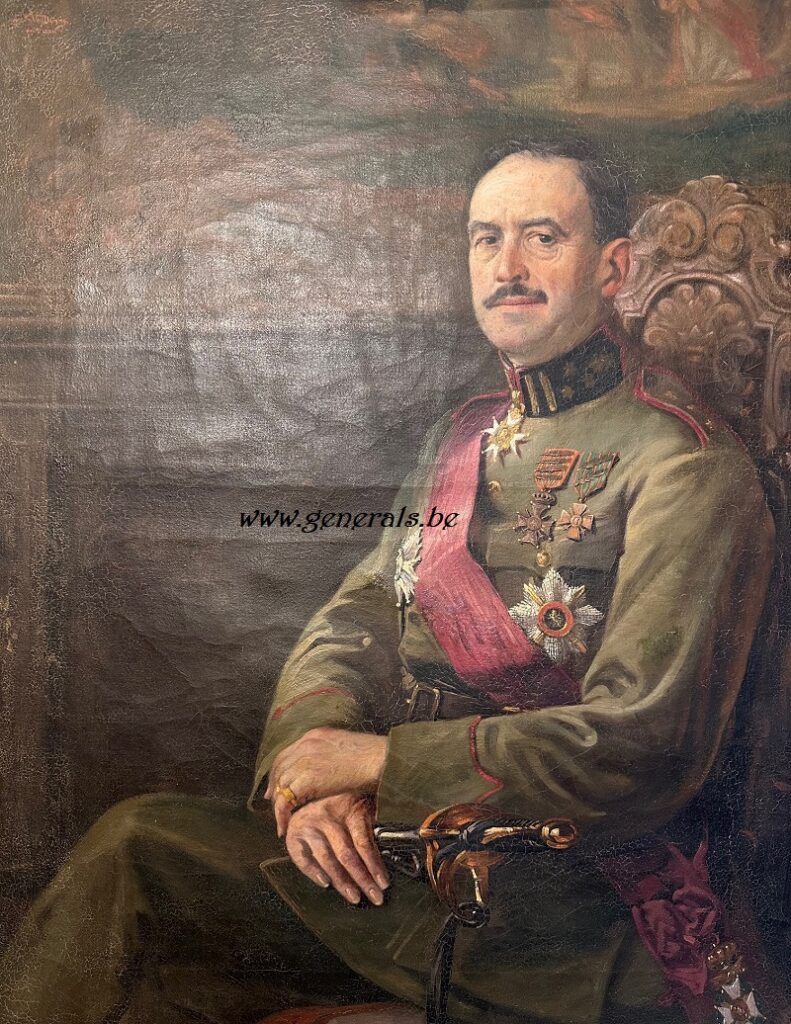
The general wears some of his many honours from Belgium and other countries.
In the portrait, we can see his Grand Cordon of the Order of Leopold, Grand Officer of the Legion of Honour of France (1918), Knight Commander of the Order of the Bath of the United Kingdom (1916) and his Belgian and French War Crosses.