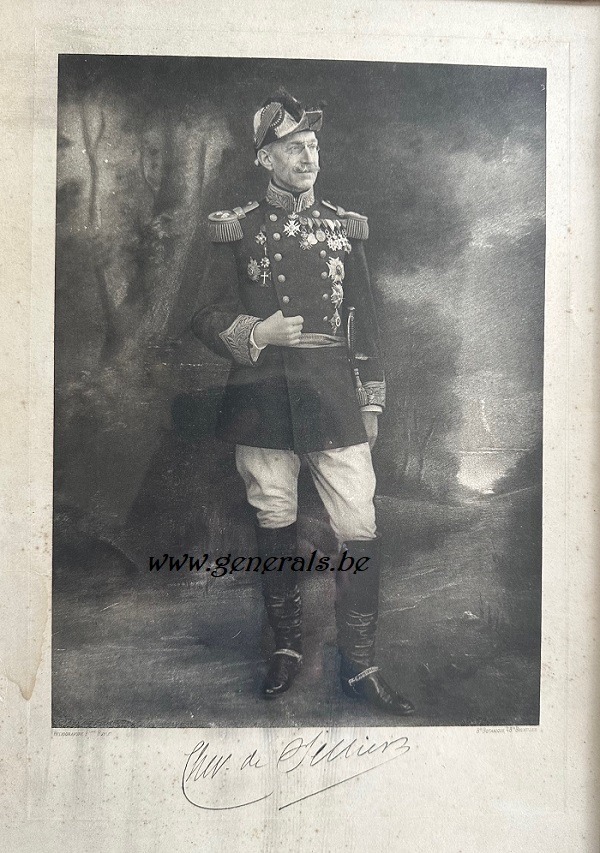
Commander of the Coast, 1918–1919.
Military attaché at the Russian Army General Headquarters, 1914–1918.
Deputy Chief of the General Staff of the Army, 1913–1914.
Grand Officer of the Order of Leopold (1920), Commander of the Order of the Crown (1913), War Cross 1914–1918 (1917), Military Cross 1st Class (1902), Government Medal of King Leopold II (1905).
Grand Cross of the Order of St Stanislaus, Russia (?), Commander of the Legion of Honour, France (1917), Knight of the Order of Christ, Portugal (1889).
Lieutenant-General Baron Louis de Ryckel played a crucial, yet often underestimated, role in Belgian strategy during the First World War.
He oversaw the complex logistics of the general mobilisation in 1913 and 1914. He advocated an active defence along the borders (such as at the forts of Liège), in contrast to the more cautious view of Chief of Staff de Selliers de Moranville. Baron de Ryckel advocated concentrating troops at the borders, specifically at the strategic forts of Liège and Namur, with the aim of forcefully halting the German advance immediately upon their entry into the country and holding the enemy back as long as possible at the Meuse Line. He enjoyed the full support of King Albert I, who preferred his proposals to those of the official Chief of Staff. King Albert I was fed up with the constant disputes between Chief of Staff de Selliers de Moranville and his subordinate de Ryckel. He simply abolished the post of ‘Chief of the General Staff’ by royal decree.
The dispute had escalated to a point where orders were no longer being followed or were contradictory. Whilst the Germans were advancing, the two senior officers were more concerned with fighting over who was right than with the enemy. By removing them, the king was able to focus on the crucial retreat to the Yser. Louis de Ryckel was sent away from headquarters. He became head of the Belgian military mission at the French General Headquarters (GQG) and later at the Russian Tsar’s court. This was a diplomatic honour, but it removed him physically from the Belgian centre of decision-making.
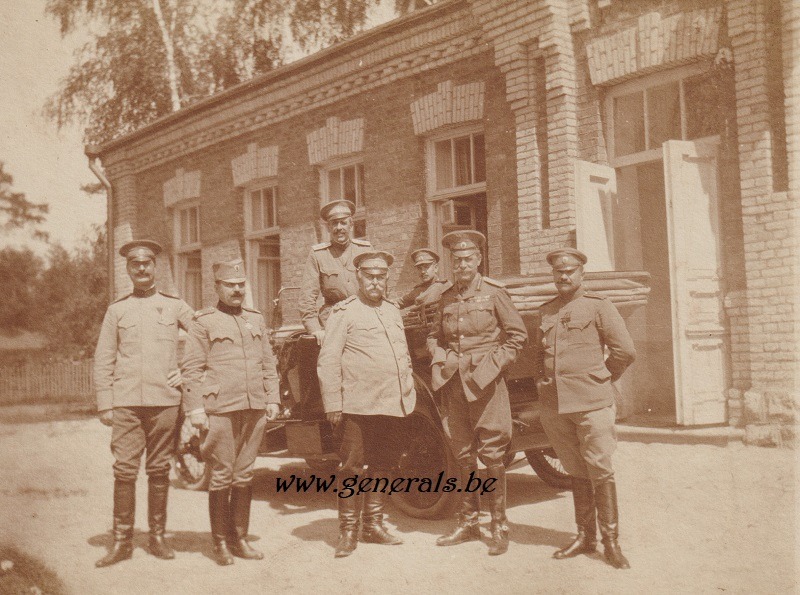
From 1914 to 1918, he was stationed at the Russian headquarters. His task was to maintain contact between the small Belgian army and the Russian giant. During this period, the Belgian ACM Corps (Auto-Canons-Mitrailleuses) also arrived in Russia. This corps of armoured cars fought on the Eastern Front alongside the Russians. Although de Ryckel did not directly command this unit in the field, as the highest-ranking Belgian officer in Russia he was their diplomatic and military liaison with the Tsar. Tsarevich Alexei was often present at headquarters to boost the troops’ morale. de Ryckel, as a representative of ‘heroic little Belgium’, was a welcome guest to the Tsar and his son. The young heir to the throne, Alexei Nikolaevich, who suffered from haemophilia and was often lonely amongst the soldiers, became fond of the experienced Belgian general. Because of de Ryckel’s affable and fatherly attitude towards the boy, he was sometimes referred to as ‘Papa de Ryckel’ in the immediate circle of the imperial family. He witnessed the collapse of the Russian Empire and the rise of the Bolsheviks in 1917. When Russia withdrew from the war following the October Revolution, Ryckel also returned to Western Europe.
After the armistice, he was given command of the coastal region. He played a key role in securing the region and rendering ammunition and German bunkers harmless before reconstruction could begin.
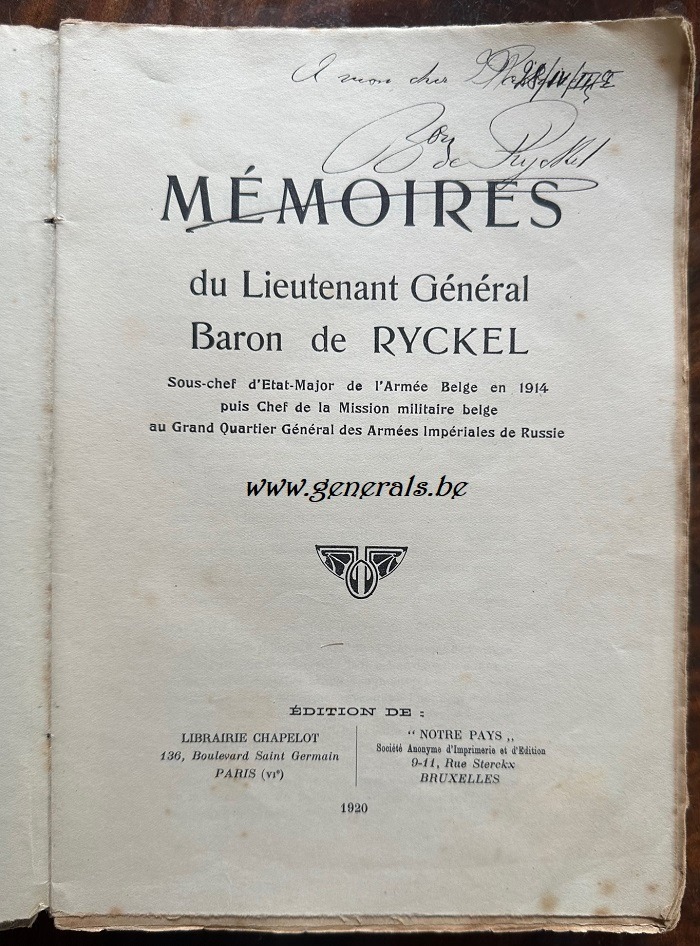
In his own Memoirs, de Ryckel describes his personal moments with the Tsarevich with great pride and emotion. He cherished the informal bond he had with the Romanovs, which stood in sharp contrast to the frosty relations he had previously experienced with the Belgian army high command in 1914.