After the fall of Antwerp, the Belgian army retreated behind the River Yser. This was the last strip of Belgian territory that was not yet in German hands. King Albert I's order was simple but extremely difficult: ‘Hold your ground to the last man.’
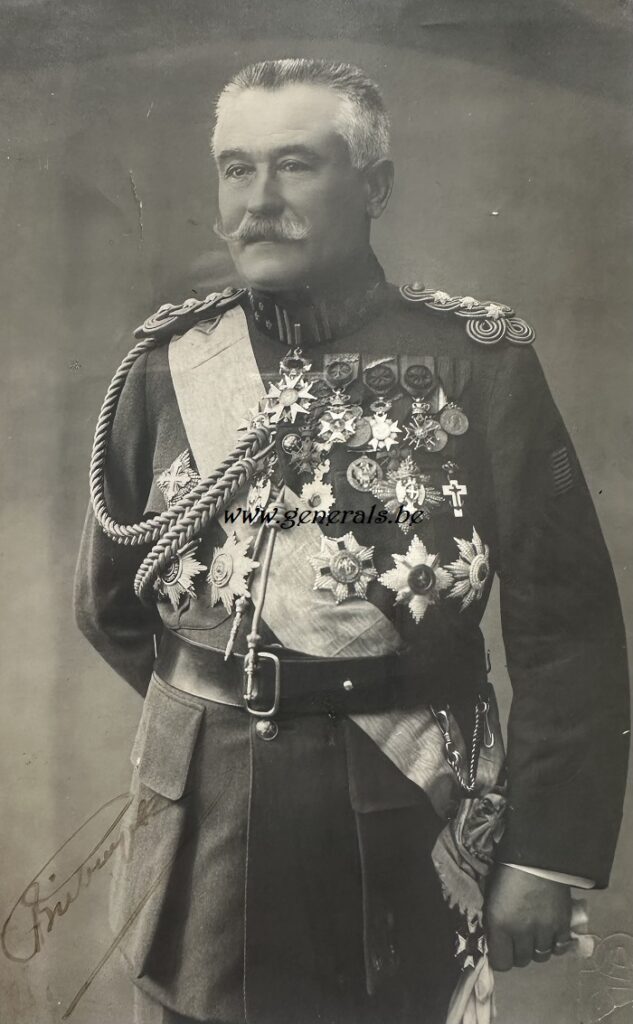
The Yser makes a sharp bend at Tervate (near Keiem). This was a weak spot in the defence. During the night of 21 to 22 October, the Germans managed to cross the Yser using pontoon bridges. The Belgian lines were in danger of collapsing. Colonel Biebuyck was ordered, as corps commander, to drive back the enemy with his 3rd Carabiniers Regiment. Without hesitation, he led his men in a daring counterattack across open terrain. Fierce hand-to-hand combat ensued. Biebuyck led the way to motivate his men, but was hit by three bullets. Although the Belgians ultimately had to abandon the Tervate Bend and fall back to the railway embankment of the Nieuwpoort-Diksmuide line, Biebuyck's action was crucial: his fierce resistance gave the Belgian headquarters the time it needed to prepare the flooding of the Yser plain. While Biebuyck was recovering in hospital, the sluices in Nieuwpoort were opened. The land between the Yser and the railway embankment was flooded, bringing the German advance to a definitive halt.
After a seven-month recovery period, he returned to the front. In August 1915, Major General Biebuyck was appointed wing adjutant to King Albert I. This was a position of trust, with Biebuyck acting as the link between the king and the troops in the trenches. He advised the king on the military situation and the morale of the soldiers.
On 8 August 1917, Lieutenant-General Biebuyck was given command of the 6th Army Division and led the so-called “Southern Group”. During this last major offensive (from September 1918), he achieved great successes: his troops liberated strategic locations such as Passchendaele, Moorslede and Ledegem, and he forced the crossing of the Leie and advanced towards the Scheldt, which hastened the final defeat of the German occupiers in Belgium.
After the First World War, he was commander of the 4th military district until his retirement in 1922.
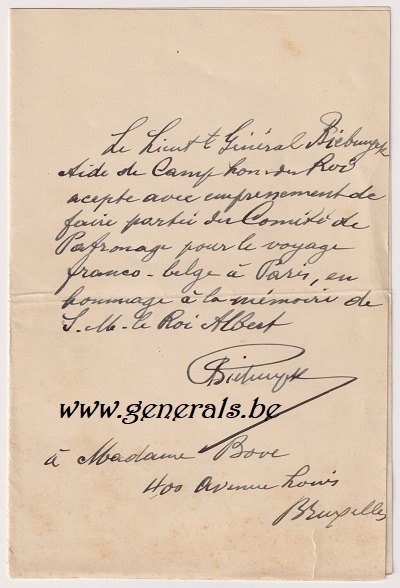
After his retirement, he continued to serve as honorary aide-de-camp to King Albert I and then to his son Leopold III, representing him at numerous official ceremonies. Until his death on 28 January 1944, he was president of the Society of the Order of Leopold.