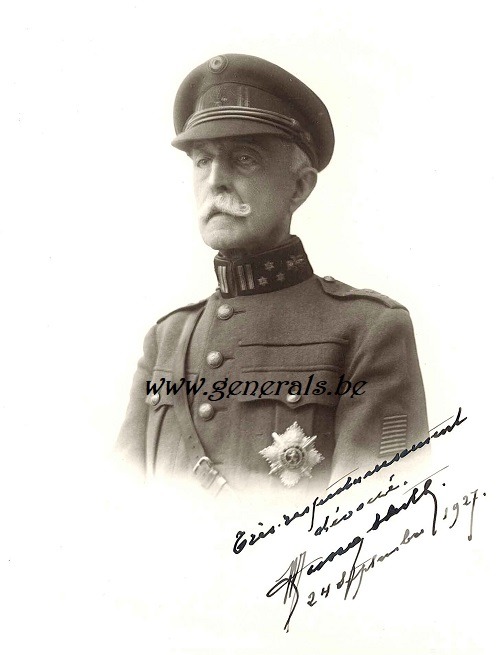
In 1888, he was entrusted with the education of the young princes Baudouin and Albert. After Baudouin's death, he developed a close, lifelong friendship with the future King Albert I.
Jungbluth was a liberal Protestant in a predominantly Catholic court, which at the time caused considerable resistance among the Countess of Flanders.
He served as Chief of Staff of the Army from 1910 to 1912 and was Head of the King's Military Household from 1912 until his death in 1930.
During the First World War, while King Albert I remained at the front in De Panne as commander-in-chief of the army, the Belgian government was in exile in Le Havre (Sainte-Adresse), France. Jungbluth acted as the King's official representative to the government.
He had to manage the often tense relationship between the King (who wanted to emphasise Belgium's neutrality) and the ministers (who wanted to cooperate more closely with the Allies).
Prime Minister and Minister of War de Broqueville argued that the King, as commander-in-chief, was subordinate to ministerial responsibility. He believed that the government (in Le Havre) should determine the strategic course.

Jungbluth and the King adhered to the tradition that the King personally commanded the army at the front (in De Panne), without interference from politicians.
The conflict ended to the detriment of de Broqueville. In May 1918, he attempted to limit the power of the Military Headquarters by establishing a ‘War Council’. The King refused this, supported by his military advisers. This ultimately led to de Broqueville's dismissal as Minister of War, just before the final offensive.
Jungbluth was also employed by the King for delicate diplomatic assignments. He maintained contacts with the French and British army command and political leaders. Because of his discretion and loyalty, he was the ideal person to convey the monarch's personal views without this immediately leading to public or political incidents.
Jungbluth was a man of few words. At a time when many courtiers and politicians leaked information to the press or the church, Jungbluth remained imperturbably loyal. King Albert I was by nature rather reserved and melancholic; in Jungbluth, he found someone who understood him without needing much explanation.
Because Jungbluth did not aspire to a political career and was not part of the Catholic party militia (he was himself Protestant and liberal), he was able to advise the king without a hidden political agenda. This gave Albert I an independent sounding board outside the official council of ministers.
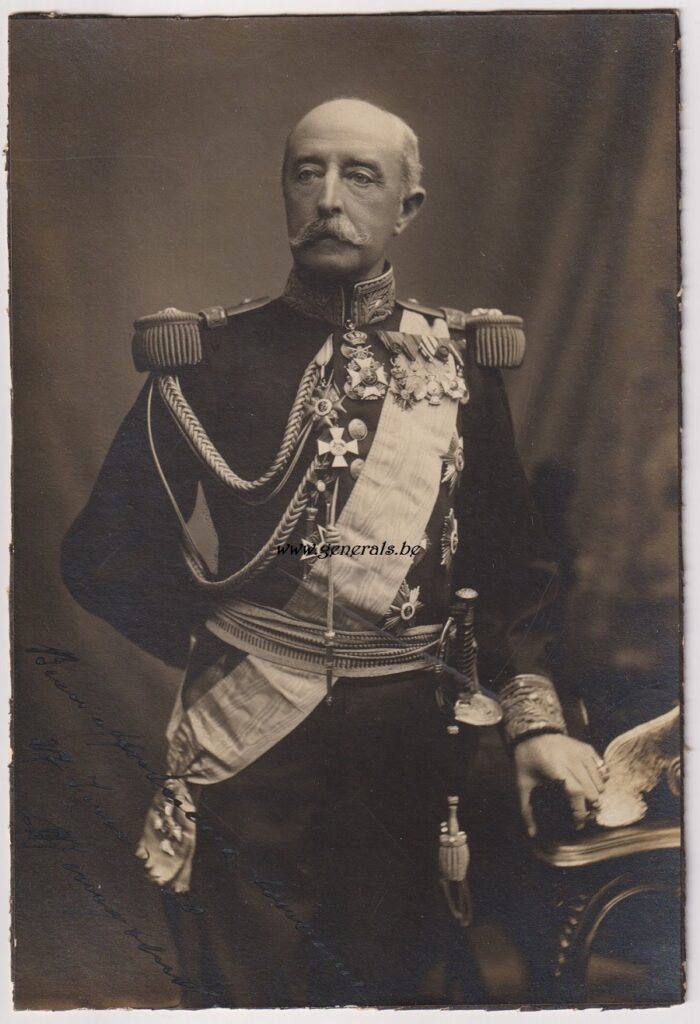
Photo taken before the First World War, I think in 1909. Jungbluth also wears the many orders awarded to him by German states as aide-de-camp to the Count of Flanders and mentor to the Princes (1888-1896), as aide de camp to Prince Albert (1896-1909), to King Albert (1909-1912) and as chief of the King's Military Household (1912-1930). Naturally, these were no longer worn after 1914.
The photo shows his Grand Cross of the Prussian Crown Order (1907), his Grand Officer of the Prussian Order of the Red Eagle (1905), Grand Officer of the Bavarian Order of Military Merit (1900, marriage of Prince Albert) and his Officer of the Princely House Order of Hohenzollern (1889).
In 1923, he received the Grand Cordon of the Order of Leopold. During his career, he received 18 Grand Crosses from foreign countries.