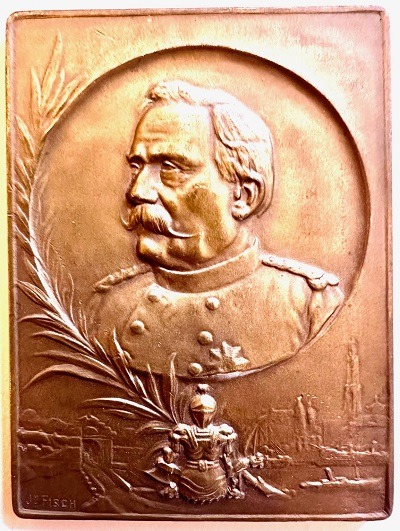
Mathieu Brialmont
His career began on 14 September 1808 when he enlisted as a soldier in the 86th Line Regiment of the First Empire. He took part in the Spanish campaigns between 1808 and 1811. Having risen to the rank of sergeant major, he took part in the Russian campaign of 1812. Promoted to lieutenant, he took part in the German campaign of 1813 and then, in 1814, as a captain, in the battles of the French campaign that took place in Italy.
After Napoleon I's abdication in April 1814, he returned to his parents' home in Seraing. During the Hundred Days, he joined the 3rd Infantry Corps under the command of Marshal Grouchy and took part in the battles of Ligny and Wavre, and therefore did not participate in the Battle of Waterloo.
On 28 January 1816, he honourably resigned from the army. Wounded three times during his many military campaigns, he was also commended on several occasions at the front.
On 13 March 1816, he enlisted in the military forces of the Kingdom of the Netherlands but did not receive his commission until 16 August 1817 as an infantry captain.
On 1 March 1819, he was placed on inactive duty at two-thirds pay because he had joined the national army after the Battle of Waterloo. In 1829, he requested full inactive duty and submitted his resignation.
Upon learning of the numerous popular uprisings in the southern provinces of the Kingdom of the Netherlands, he joined the Belgian revolution in September 1830. He led the assault during the siege of Venlo (NL) and was appointed military commander. During the Ten Days' Campaign, despite being isolated, he managed to hold the position. This earned him the rank of lieutenant-colonel.
Having become a colonel, on 28 November 1836 he was appointed commander of the strategically important city of Antwerp.
After being appointed aide-de-camp to King Leopold I on 18 July 1842, he held the position of aide-major general, created especially for him, and that of Minister of War from 12 august 1850 till 13 june 1851. He ended his military career at the age of 65 on 14 March 1854. At that time, he was Lieutenant General and Commander of the 4th Territorial Division and the 4th Infantry Division.
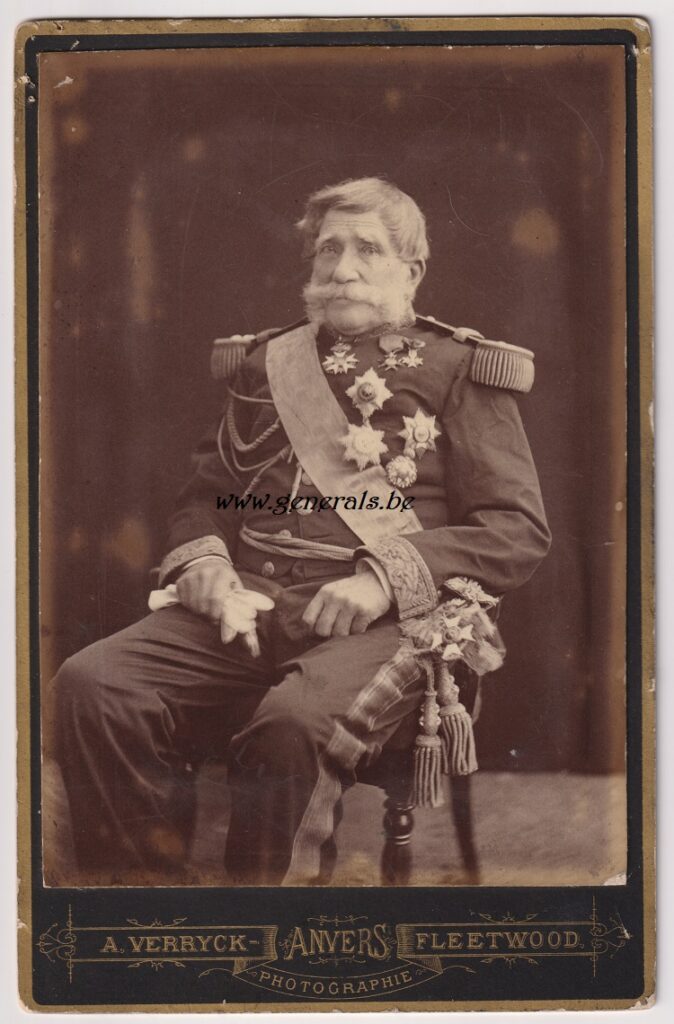
Lieutenant General Mathieu Brialmont in later life. He is wearing his Grand Cordon of the Order of Leopold (1878), his Grand Crosses of the Order of the Rose of Brazil (1867), the Ducal House Order of Saxony (?) and the Order of Christ of Portugal (1855). He also wears his Commander of the Legion of Honour of France (1854), his Iron Cross 1830 of Belgium and the Saint Helena Medal of France.
Henri Alexis Brialmont
Henri Alexis Brialmont was born in 1821 as the son of Matthieu Brialmont. In 1838, he began his military training at the Royal Military Academy in Brussels as a member of the 5th Artillery & Engineering class (predecessor of the current Polytechnic programme at the RMA). In 1847, he was assigned to the cabinet of the Belgian Minister of War as a lieutenant in the Engineering Corps. There, he expanded the Belgian army and helped introduce conscription.
From 1858 until his death in 1903, he was mainly involved in the design and construction of the forts around Antwerp (see Antwerp Defence Line), Liège and Namur. He warned the Belgian government against making a capital mistake by not building a fort near the town of Lieze. This proved to be a strategic blunder during the German invasion in 1914. However, this mistake was rectified in 1932 with the construction of Fort Eben-Emael in the immediate vicinity. Brialmont subsequently applied his expertise in fort construction to the design of forts abroad (Romania, Greece and Turkey).
In 1874 he was promoted to major general and was appointed to oversee the fortifications of Belgium's major port, Antwerp, the same year. In 1875, he became Inspector General of the Engineers and Fortifications and in 1877 he was promoted to Lieutenant General
In 1882, the Romanian king and government asked him to inspect and study the Romanian fortifications. Following a complaint from the Austrians about Brialmont's visit, the Belgian government suspended him from duty. In 1884, he was recalled to the army and reinstated to the rank of Inspector General of Engineering and Fortifications.
In 1891, the fortifications at Liège and Namur were completed. However, because the budget had been exceeded, he was forced to retire.
In June 1892, Brialmont was elected as a liberal representative for the district of Brussels, enabling him to defend his ideas in parliament. He belonged to the liberal party, which at the time included his greatest opponents, foremost among them Walthère Frère-Orban, but by then they had either died or left politics. Brialmont belonged to the group of liberal progressives and was in favour of universal suffrage. In addition, he advocated for a reorganisation of the army by replacing the existing system of conscription, whereby recruits selected by lottery could buy their way out of enlistment by paying a hefty sum, with a system of compulsory military service whereby one son per family would be called up.
There has probably been no other military man in Belgium who has defended his views with such steadfastness and over such a long period of time in books, pamphlets and articles. In his publications on fortification, he consistently showed himself to be an advocate of the polygonal system. He also wrote biographies dedicated to great military leaders.


Signed photograph of Lieutenant General Brialmont. He is wearing his Grand Cordon of the Order of Leopold, awarded in 1888.