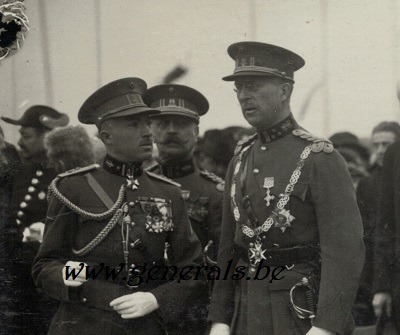
Raoul Van Overstraeten was an influential Belgian general who was best known as King Leopold III's chief military adviser in the run-up to and at the start of the Second World War.
Raoul Van Overstraeten was born on 25 January 1885 in Ath, the son of a Dutch-speaking officer and his French-speaking wife.
In 1902, he became a cadet at the Royal Military Academy and joined the artillery.
On the eve of the Great War, he was a staff officer and liaison officer with the staff of the cavalry division commanded by general de Witte (de Haelen). He advocated defensive tactics rather than charges with the sabre and thus contributed undeniably to the victory in the Battle of Halen, known as the “Battle of the Silver Helmets”, on 12 August 1914.
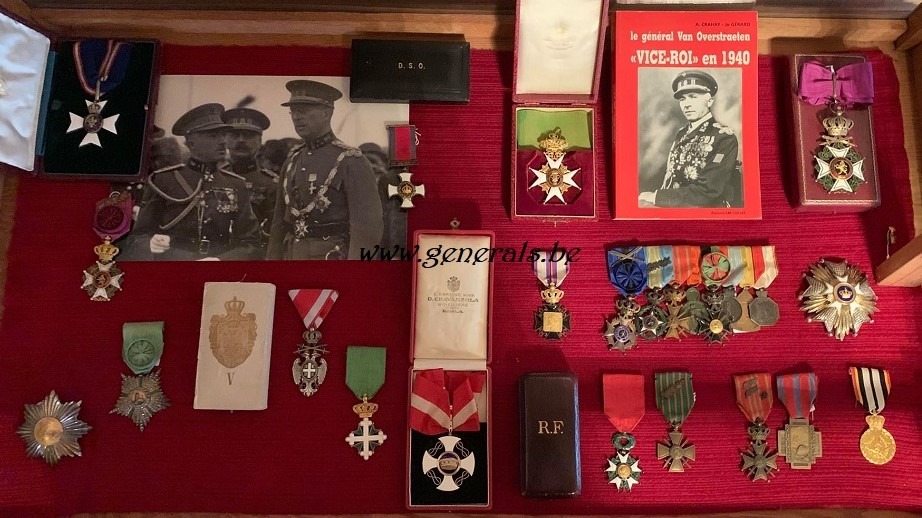
For his bravery, he was awarded the Order of Leopold with palm on 15 May 1915 and the War Cross with two palms and lion by Royal Decree of 15 September 1916. He was also mentioned in the French army's order of the day.
He was wounded and promoted to captain in November 1914. He left for East Africa as a liaison officer with the British because, in his opinion, the Belgian front was “too boring”. If his Mémoires are correct, it was thanks to his good advice that the small Belgian expeditionary force under General Tombeur was able to capture Tabora, the capital of the German colony, and thus pull the rug out from under the British. The success of his mission in Africa was rewarded upon his return to Belgium in July 1917 with an appointment as Equerry to King Albert.
This was mainly at the insistence of General Biebuyck, as Van Overstraeten preferred to see ‘action’.
For his services in the Belgian Congo, he was awarded the Knight's Cross of the Order of the African Star with palm on 6 April 1917, one of 49 awards made during the First World War.

On 20 July 1917, he received the high British distinction of the Distinguished Service Order.
For his services during the First World War, he also received the Cross of Knight of the Legion of Honour and the French War Cross, as well as the Knight's Cross of the Order of the White Eagle of Serbia with swords.
On 22 September 1933, he was appointed aide-de-camp to King Albert I, and later to his successor, King Leopold III.
After King Leopold III ascended the throne, he also became the king's military adviser.
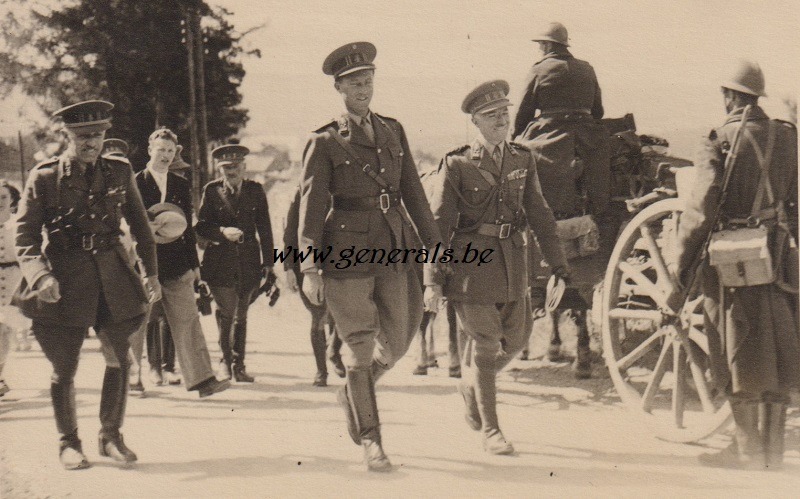
During manoeuvres in 1938, general Denis, king Leopold III and general Van Overstraeten.
His role as adviser was characterised by:
Architect of neutrality: He was a staunch supporter of Belgium's policy of independence, whereby Belgium remained outside military alliances with France and Great Britain so as not to provoke Germany.
Dominance over the General Staff: British and French officers noted that Van Overstraeten had enormous ascendancy over the King, which often made consultations with the official Belgian Chief of Staff pointless.
Strategic choices in 1940: During the Eighteen Days' Campaign, he led operations behind the scenes. He insisted on defending the Leuven line, even when Allied generals such as Brooke dismissed his suggestions as unrealistic.
During the crucial days in May 1940 (just before the capitulation), Van Overstraeten was present at the dramatic confrontation between the King and his ministers at Wijnendale Castle.
The ministers wanted to go to France to continue the fight; the King wanted to remain with his troops.
Van Overstraeten unconditionally supported the King in this decision. After the war, the government in exile regarded this as a form of treason against the national cause.
Diplomatic mediator: After the capitulation, he was the one who organised the meeting between Leopold III and Adolf Hitler in Berchtesgaden on 19 November 1940.
During the occupation, he was less physically present with the monarch, who was “imprisoned” in the castle of Laeken, but he did escape internment in a German Oflag. He remained in Brussels and occasionally carried out assignments for the King, which did not always prove to be opportune.
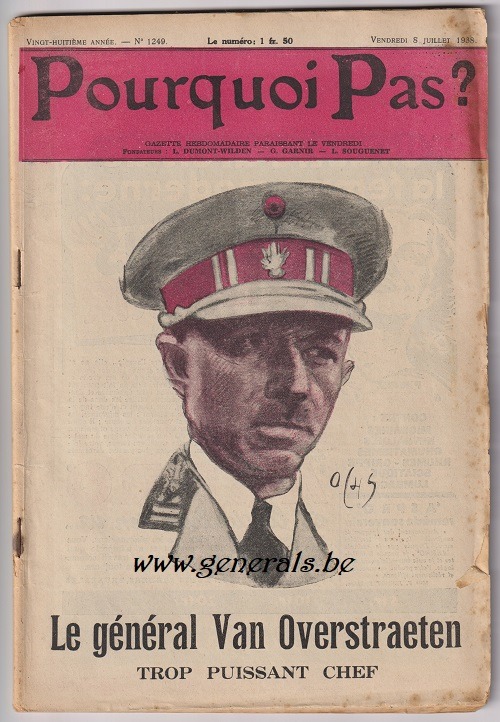
After the war, because of his great influence, he was also referred to as the “viceroy” in critical biographies such as those by general Crahay and Gerard.
In the aftermath of the Second World War, Raoul Van Overstraeten was at the centre of the storm during the Royal Question (the political struggle over the return of Leopold III to the throne). Although he was a military man, he was seen by many as the instigator of the political course that had isolated the King.
When the Royal Question culminated in 1950 with Leopold III's abdication in favour of Baudouin, Van Overstraeten's public and political role also came to an end.
He withdrew from public life and devoted the rest of his years to writing his memoirs in order to justify his actions and those of the King.
Leopold III did not forget him: after his return to Belgium in the summer of 1950, General Van Overstraeten was one of the first personalities to be received by the monarch. And the Palace gave him one last recognition for his unwavering loyalty: in 1954, under a homogeneous Catholic government, he was appointed honorary lieutenant-general by King Baudouin.
He died in Brussels on 30 January 1977.
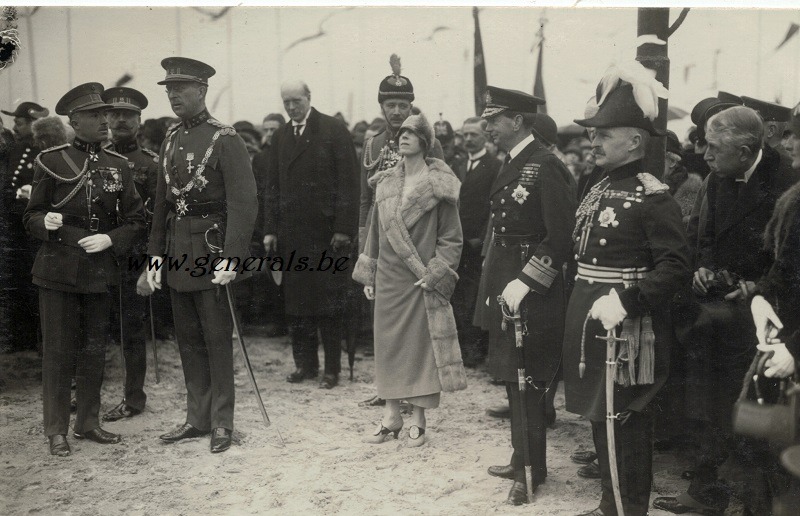
Photograph of Van Overstraeten with King Albert, Queen Elisabeth and Admiral Keyes at the inauguration of the monument for St. George's Day in Zeebrugge on 23 April 1925. Van Overstraeten is clearly wearing his Commander of the Royal Victorian Order, his DSO and his Knight of the Order of the African Star with Palm. He received his CVO on the occasion of the state visit of the British monarchs to Brussels in October 1922.